Would you like to help shape the user interface for Fusion Applications? Oracle's User Experience groups have established a means for users to test and provide feedback on user interfaces for upcoming releases of Oracle software products. The Usability Program provides users with the opportunity to test and provide feedback on the look and feel of user interfaces for Oracle software products under development.
As these words are written, Oracle is actively seeking users of all skill levels and experience to join the Usability Program. This is a chance to help shape the future look and feel of Oracle products.
You can learn more about Oracle's User Experience effort here, and you can join the Usability Program here.
Thursday, July 27, 2006


Tuesday, July 25, 2006
The Oracle Integration Repository - Escape From API Purgatory
Earlier this year, I experienced the "thrill" of pouring through Oracle documentation in search of details on a few APIs. About 2 a.m., my eyes were burning like they were on fire and I still lacked much of the info I needed. As this experience has been a recurring nightmare, you might imagine how happy I was last spring when I learned about the Oracle Integration Repository (one of the many things I learned during the Middleware SIG meeting at Collaborate ’06).
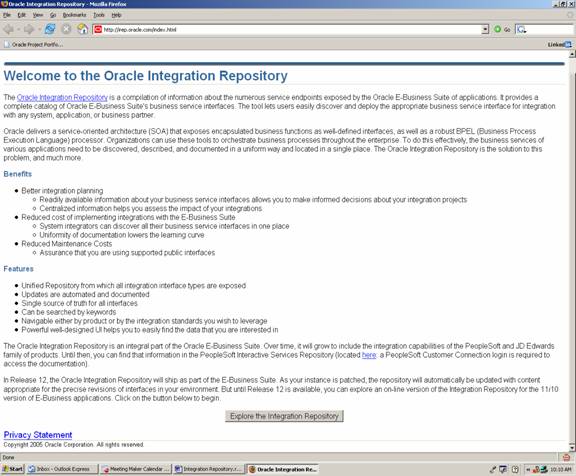
The Oracle Integration Repository lists and provides information on all service endpoints in the E-Business Suite.The intent is to let “…users easily discover and deploy the appropriate business service interface for integration with any system, application, or business partner.”
The repository can be searched by application product family, drilling down into specific application modules:
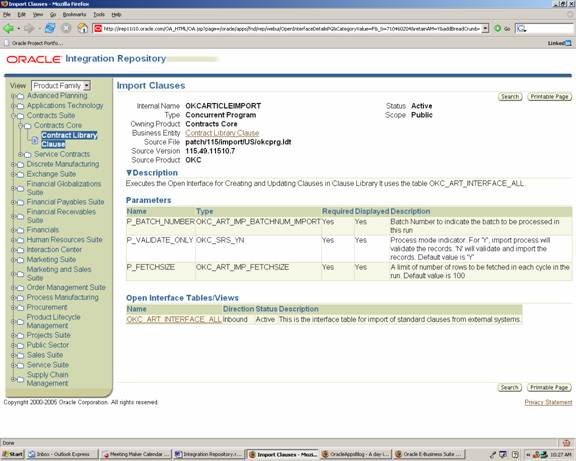
The repository can also be searched by standard:

Upon drilling into an API, you’ll find brief but informative details:
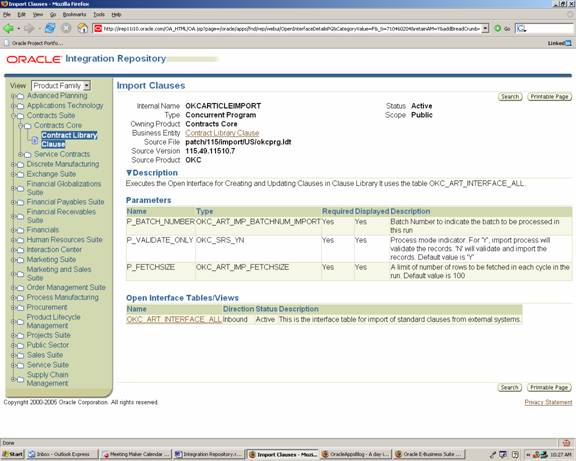
Now, it's obvious to all that my screenshots here are pretty weak. I strongly encourage you to check out the Oracle Integration Repository for yourself. The repository for 11i is available on-line here. The repository for Release 12 will be part of your rapid install, and will be updated as needed when the instance is patched; it will also be available on-line...one can only hope that the same can soon be said for PeopleSoft, JD Edwards and Siebel.
Consolidating all the E-Business API information into one source is a solid and worthwhile endeavor on Oracle’s part. In fact, The Oracle Integration Repository has already “saved my bacon” more than once – I highly recommend checking it out.
Friday, July 21, 2006
The Upshot of Applications Unlimited
Now that the smoke has started to settle from Oracle’s unveiling of Applications Unlimited earlier this year, it seems like a good time to review the high points of the program and the impact on Oracle customers.
In the simplest terms, Applications Unlimited is Oracle’s program for continuing to enhance and support all Oracle applications (including PeopleSoft, JD Edwards and Siebel) with dedicated teams so long as customers are willing to pay for those services. No forced migrations, no deadlines, no required moves to Fusion applications.
As I understand it, the support offered under Applications Unlimited is tied to Oracle’s Lifetime Support policy. Lifetime Support offers a tiered approach to support services, stair-stepping through reductions in support services and increases in support costs as time passes since the products General Availability release. You can learn more about Oracle’s Lifetime Support policy here.
So, what’s the upshot of Applications Unlimited? From my perspective, there are at least two significant long-terms impacts for Oracle customers…and they’re both positive.
First, Applications Unlimited provides Oracle Applications customers some measure of control in determining when, if ever, they will upgrade their applications or move to Fusion Applications. The decision will essentially consist of a trade-off between the costs of remaining on the current version versus the benefit of upgrading or migrating…and that decision will rest in the hands of each Oracle Applications customer.
Second, it puts the burden on Oracle to give customers a reason to upgrade. They’ll be compelled to provide outstanding value propositions in order to persuade customers to upgrade or migrate…because customers will always have the option of sticking with what they’ve got.
In the simplest terms, Applications Unlimited is Oracle’s program for continuing to enhance and support all Oracle applications (including PeopleSoft, JD Edwards and Siebel) with dedicated teams so long as customers are willing to pay for those services. No forced migrations, no deadlines, no required moves to Fusion applications.
As I understand it, the support offered under Applications Unlimited is tied to Oracle’s Lifetime Support policy. Lifetime Support offers a tiered approach to support services, stair-stepping through reductions in support services and increases in support costs as time passes since the products General Availability release. You can learn more about Oracle’s Lifetime Support policy here.
So, what’s the upshot of Applications Unlimited? From my perspective, there are at least two significant long-terms impacts for Oracle customers…and they’re both positive.
First, Applications Unlimited provides Oracle Applications customers some measure of control in determining when, if ever, they will upgrade their applications or move to Fusion Applications. The decision will essentially consist of a trade-off between the costs of remaining on the current version versus the benefit of upgrading or migrating…and that decision will rest in the hands of each Oracle Applications customer.
Second, it puts the burden on Oracle to give customers a reason to upgrade. They’ll be compelled to provide outstanding value propositions in order to persuade customers to upgrade or migrate…because customers will always have the option of sticking with what they’ve got.
Tuesday, July 18, 2006
You Can Be Involved in Fusion
Are you frustrated over your inability to provide suggestions on Fusion Applications to Oracle? Do you wish you had more information on the progress and future of Fusion? Do you need more technical info on Fusion middleware? If your answer to any of these questions is a resounding "Yes!", may I suggest that the best remedy is to get up from your chair, get out in the Oracle user community, and get involved?
Oracle has established several channels for two-way communication with customers about Fusion Applications. Some of these communications channels include:
1. Customer Advisory Boards – Oracle is working with the International Oracle User Council ("IOUC") to establish Customer Advisory Boards for various business process areas (i.e., HR, Projects, Financials, etc.). You can discover more about this and other IOUC Fusion-related initiatives by checking the IOUC’s Fusion Channel here.
2. OAUG’s Enhancement Request System – If you’re an Oracle Applications User Group (“OAUG”) member, you should know that OAUG is currently utilizing their Enhancement Request System to determine a set of features that Oracle customers would like to see in Fusion Applications. That feature set will be submitted to Oracle. You can learn more here, but hurry – voting ends on July 31, 2006.
3. OAUG Fusion Council – OAUG sponsors a Fusion Council in partnership with Quest (the JD Edwards User Group) and the PeopleSoft Users Group. The purpose of the Council is, among other things, to “…represent users of Oracle, former J.D. Edwards and PeopleSoft applications and customers to Oracle development in the design, usability and business functionality features of Fusion…” I’m personally a member of both the Council and the Steering Committee, and have found this communications channel to be an outstanding means of both voicing my concerns with Oracle and learning about the latest Fusion developments. You can read about the Fusion Council here.
4. IOUG and OAUG Middleware SIGs – Both the Independent Oracle Users Group (“IOUG”) and OAUG sponsor middleware Special Interest Groups (“SIGs”), both of which convey significant information on Fusion Middleware and Fusion Applications. You can access the IOUG Middleware SIG here and the OAUG Middleware SIG here.
Now that I’ve listed several (but by no means all) of these communications channels for Fusion, have you noticed a pattern? All these channels are collaborations between Oracle and Oracle user groups. Actively engaging with user groups is the very best way to for Oracle to hear your input on Fusion. You’ll also be on the leading edge in learning about the latest Fusion developments.
The combination of Fusion Middleware and Fusion Applications will likely be a monumental change in the Oracle E-Business realm. You can partcipate in shaping that change, or stand back and watch it happen. The choice is yours.
Oracle has established several channels for two-way communication with customers about Fusion Applications. Some of these communications channels include:
1. Customer Advisory Boards – Oracle is working with the International Oracle User Council ("IOUC") to establish Customer Advisory Boards for various business process areas (i.e., HR, Projects, Financials, etc.). You can discover more about this and other IOUC Fusion-related initiatives by checking the IOUC’s Fusion Channel here.
2. OAUG’s Enhancement Request System – If you’re an Oracle Applications User Group (“OAUG”) member, you should know that OAUG is currently utilizing their Enhancement Request System to determine a set of features that Oracle customers would like to see in Fusion Applications. That feature set will be submitted to Oracle. You can learn more here, but hurry – voting ends on July 31, 2006.
3. OAUG Fusion Council – OAUG sponsors a Fusion Council in partnership with Quest (the JD Edwards User Group) and the PeopleSoft Users Group. The purpose of the Council is, among other things, to “…represent users of Oracle, former J.D. Edwards and PeopleSoft applications and customers to Oracle development in the design, usability and business functionality features of Fusion…” I’m personally a member of both the Council and the Steering Committee, and have found this communications channel to be an outstanding means of both voicing my concerns with Oracle and learning about the latest Fusion developments. You can read about the Fusion Council here.
4. IOUG and OAUG Middleware SIGs – Both the Independent Oracle Users Group (“IOUG”) and OAUG sponsor middleware Special Interest Groups (“SIGs”), both of which convey significant information on Fusion Middleware and Fusion Applications. You can access the IOUG Middleware SIG here and the OAUG Middleware SIG here.
Now that I’ve listed several (but by no means all) of these communications channels for Fusion, have you noticed a pattern? All these channels are collaborations between Oracle and Oracle user groups. Actively engaging with user groups is the very best way to for Oracle to hear your input on Fusion. You’ll also be on the leading edge in learning about the latest Fusion developments.
The combination of Fusion Middleware and Fusion Applications will likely be a monumental change in the Oracle E-Business realm. You can partcipate in shaping that change, or stand back and watch it happen. The choice is yours.
Monday, July 17, 2006
Oracle's Own E-Business Suite Global Single Instance
I get quite a few questions, mostly from people I work with, about Oracle's own E-Business architecture. Fortunately, Oracle's Steven Chan responded to these questions in his own blog. Both this particular post and Steven's entire blog are worth checking out.
The article on Oracle's own E-Business architecture is at http://blogs.oracle.com/schan/2006/07/12#a429
You can find Steven Chan's Oracle E-Business Suite Technology blog at http://blogs.oracle.com/schan/
The article on Oracle's own E-Business architecture is at http://blogs.oracle.com/schan/2006/07/12#a429
You can find Steven Chan's Oracle E-Business Suite Technology blog at http://blogs.oracle.com/schan/
Friday, July 14, 2006
Opening Comments
My intent is starting the ORCLville blog is to provide a means for sharing and discussing the numerous and rapid changes developing in the universe of Oracle E-Business applications. As the apps have grown from the original character-based days to the current N-tiered architecture with GUI user interfaces and thousands upon thousands of feature points, the complexity and rate of change have also increased. Throw in the recent boatload of corporate acquisitions and the journey to Fusion, and the sheer number of changes becomes nearly overwhelming. I hope this blog will be my individual contribution to helping Oracle E-Business Users make some sense of all this change.
This is my first attempt at blogging, so I'm worried about my ignorance regarding protocol and courtesy. I'm also concerned about basic journalist concerns: bad writing, information accuracy, or sharing flat-out bad ideas. So I hope you'll stick with me while I get the hang of this blogging thing.
This is my first attempt at blogging, so I'm worried about my ignorance regarding protocol and courtesy. I'm also concerned about basic journalist concerns: bad writing, information accuracy, or sharing flat-out bad ideas. So I hope you'll stick with me while I get the hang of this blogging thing.
Four Things I Think I Know About Oracle Fusion
After several months of wading through information and misinformation on Oracle Fusion, I thought it might be helpful if I took this opportunity to share four things I think I know about Fusion.
I can’t say that I know any of these things about Fusion for certain, as the sands are constantly shifting beneath all our feet…things could change very quickly. Rely on my thoughts here at your own risk.
It also seems difficult to get information from Oracle about Fusion Applications...probably because the effort is still in the early stages, so there is a very limited amount of information to share. Hopefully more information will be available as the project progresses.
With all the appropriate caveats out of the way, this is what I think I know about Fusion. Perhaps you’ll find some value in my thoughts.
1. Applications or Middleware?
Fusion is composed of two parts: middleware and applications
Fusion Middleware is a rebranding of the Oracle Application Server and other technology stack components that Oracle has acquired (and continues to acquire, at least for the moment). Fusion Middleware is available for deployment right now.
Fusion Applications are anticipated to be the synthesis of ERP, MFG, and CRM product suites that Oracle has acquired or developed. Fusion Applications are planned for a 2008 release.
The remaining thoughts here pertain to Fusion Applications.
2. Oracle Is Not Merging Code for Fusion Applications
Fusion is not a “code merge”, but a rearchitecting of the E-Business Suite (EBS) using service-oriented architecture (SOA) principles with additions in functionality from PeopleSoft, JD Edwards, and Siebel.
Oracle has told us repeatedly that the EBS is the data model for Fusion Applications. Given the close relationship between business logic and data models, we can infer with a high degree of probability that the business logic of Fusion Applications will be deeply rooted in that of EBS.
So far as the user interface goes, we can only speculate at this time. Hopefully, the infusion of all those PeopleSoft User Interface Engineers into Oracle’s development organization will provide some outstanding results.
3. For Oracle EBS Users, Fusion Will Be An Upgrade; For Others, It Will Be A Migration
For EBS users, the move to Fusion will be similar to an upgrade…a bit more complex than moving from 10.7 to 11i, but more like an upgrade than a new system implementation. EBS users moving to Fusion can probably anticipate a new architecture, some business process changes (due to the functionality brought in from the acquired products and the emphasis on SOA), integration of Fusion Middleware technology, and a new user interface.
For PeopeSoft, JD Edwards, and Siebel users, the move to Fusion will be more complex…more like a migration to a new product. Licensing costs, especially for Fusion middleware products, should be considered in your planning. In addition, changing the business logic and user interface will result in a substantial effort in dealing with process changes.
4. Applications Unlimited
Oracle’s “Applications Unlimited” announcement detailed the company’s long-term commitment to provide continued enhancements to current Oracle Applications beyond the delivery of Oracle Fusion Applications in 2008. As a result of this new policy, the question for all Oracle Apps users becomes one of considering the value proposition in upgrading or migrating to Fusion Applications.
Although the future release of Fusion promises a synthesis of business processes, functionality and user interfaces from all current Oracle application products, we’ll all need to carefully weigh that value against the cost of moving to Fusion. This weighing will be especially important now that the Applications Unlimited program may allow us to stick with the product line (EBS, JD Edwards, PeopleSoft and Siebel) that we’re already using.
Well, there you have it. These four points represent my perspective on Fusion, and comes only after investing many hours in research as well as participation in OAUG’s Fusion Council and Fusion Council Executive Steering Committee. As Fusion continues to unfold, it will be interesting to see if I really knew what I thought I knew ;)
Subscribe to:
Posts (Atom)