Saturday, December 30, 2006

The Great Laptop Giveaway

I read an article today on Microsoft's recent laptop giveaway. It's a bit off-topic, but pretty amusing, so I thought it was worth sharing.

It seems Microsoft recently provided prominent bloggers with free, top-of-the-line laptops pre-loaded with the new Microsoft Vista operating system. Apparently, these were some pretty spiffy laptops:

"According to Microsoft blogger Long Zheng, his Ferrari 5000 came with an AMD Turion 64 X2 dual-core 2GHz CPU, 2GB of DDR2-667 RAM, AMD-ATI Mobility Radeon X1600 graphics, and a 15.4-inch widescreen LCD. It also has a 160GB SATA drive, HD-DVD reader and burner, and a 1.3 megapixel camera. The system would cost approximately $2,299."

To make a long story short, it seems there is now some fuss brewing over the credibility of the bloggers who accepted the laptops. So much fuss, in fact, that Microsoft now wants its laptops back. I wish them luck in trying to get that horse back into the barn.

Personally, the credibility issue is big with me. So I want everyone reading to know that my credibility is intact. Yesiree Bob, nobody has offered me any freebies on the basis of this blog: no laptops, no Oracle software, not even a cheapo pen or a lousy giveaway hat.

*sigh* I wonder what I'm doing wrong ;)

Tuesday, December 12, 2006

Fusion Apps - Oracle's Build Plan

In my role as Co-Chair of OAUG's Fusion Council, I'm often asked about Oracle's plan for building Fusion Applications: what is the plan and what is the current project status? Oracle gave us some great information in this regard during and immediately after Oracle OpenWorld.

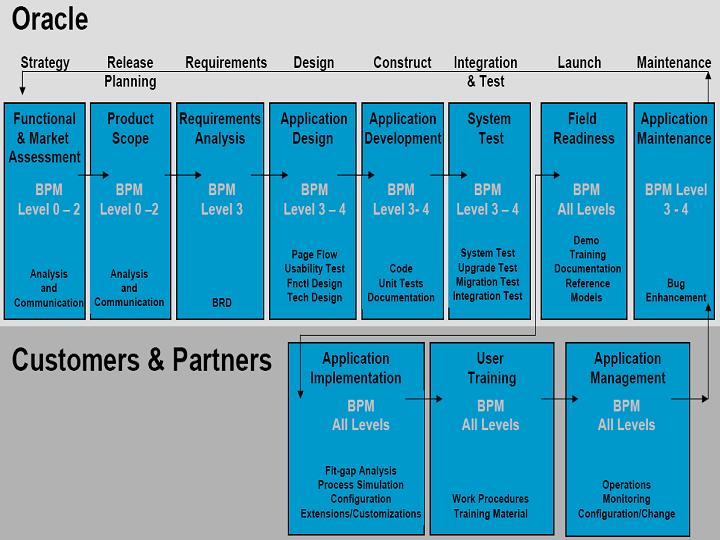
Oracle's Pat Krebs and Joe Gum, partnering with IDS Sheer's Olaf Geyer, gave a presentation at OpenWorld titled "Oracle Fusion Business Process Models". You can download the slides from the presentation by searching for Session ID S282318 here. The best overall presentation I've seen of the Fusion Apps development roadmap came during this presentation:


Although you may have to squint a bit due to Blogger's limitations in delivering images within blog text, the extra effort will be worth it. This visual ties Lifecycle Stages (Strategy, Release Planning, etc.) with application product management phases (Functional & Market Assessment, Product Scope, Requirements Analysis, etc.) and classic deliverables (Business Requirements Doc, Functional Design, Technical Design, etc.). It also does a fine job of segregating iterative product development (the "Oracle" portion) from application implementation and support (the "Customers and Partners" portion)...although I'm very sure Oracle will be very active in offering services for applications implementation, user training, and application management (the product development phases found in the "Customers and Partners" section of the visual).

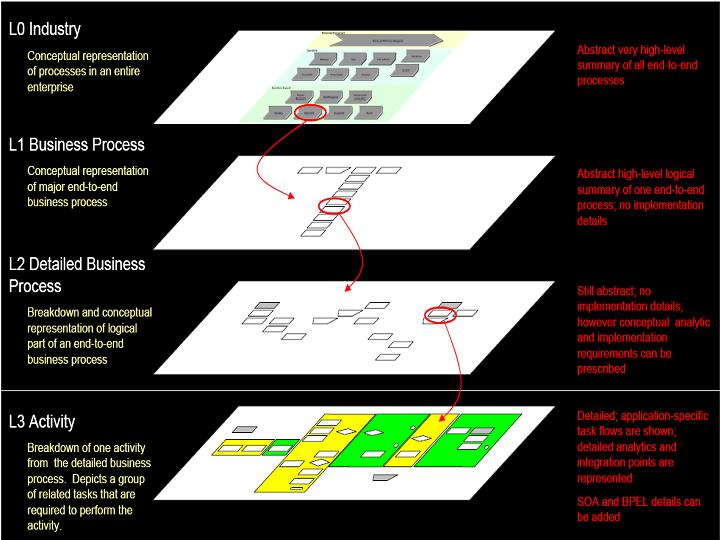
After seeing this picture, you're likely asking yourself "just what the heck is BPM Level whatever?" BPM is "Business Process Model". The levels are best explained by the following picture (taken from the same presentation; prepare for more squinting):


So, how far has Oracle progressed in creating Fusion Applications? The last status report I heard, which was in early November, indicated that the BRDs were almost wrapped up. Considering that news in light of the first visual, it seems to me that there is a challenging amount of work to be done in a short period of time to support a 2008 release...not impossible, just challenging. I'll update you as soon as I have more recent information.

Sunday, December 03, 2006

Exciting Fusion News for Functional Folks - Oracle's BPA Suite

Years ago, I came into the Oracle world as a functional or business systems analyst type of person. So I get excited when something new and exciting happens for these types of folks. This is one of those times.

Oracle has recently released an evaluation version of the 10.1.3.1. Business Process Analysis ("BPA") Suite. You can download the BPA Suite for evaluation purposes here. The BPA Suite is essentially the IDS Scheer ARIS business process tools reworked to integrate with Fusion Middleware. This early release only includes the Business Process Architect tool; the remaining components will be included at a later time. In my opinion, this release is not ready for any type of "prime time" use. However, it is still most definitely worth exploring!

For Windows Users, the BPA Suite is an easy install - it took me all of 15 minutes to download and install. I worked through the Quick Start Guide, then I was off and running in building my own business processes. For those of us who use non-Windows systems, find a Windows box. I tried to run the BPA Suite on a RedHat Linux box within a WINE environment - save yourself some frustration, swallow the bitter pill, and find a Windows box for this evaluation.

Using the BPA Suite, a functional person can map out or extend a business process, and...wait for it...translate that business process into a BPEL-executable format. Consider building a business process much like you might build a workflow process in Oracle Workflow Builder today, but building it within a Visio-like environment with a Visio-like tool set. The BPA Suite, or at least the Business Process Architect component of the BPA Suite, is very easy use and has a very flat learning curve. For a first iteration, this is good stuff!

As I started building some complex business process designs, I did find it helpful to conceptualize my business processes in four layers: Level 0, which describes all the business processes in an enterprise; Level 1, an end-to-end representation of a major business process (i.e., Procure-to-Pay); Level 2, a detailed, step-by-step representation of a business process; Level 3, where all of the detailed tasks and services are mapped out for a business process. Needless to say, I'm not creative enough to have come up with this on my own. I learned this 4 level model from the "Oracle Business Process Modeling and Analysis" presentation made by Oracle's Pat Krebs at Oracle OpenWorld.

As my imagination races into the future with the BPA Suite, I can visualize delivering a Functional Design for a business process that consists of: 1) The business process design, including the first iteration of a BPEL executable; 2) determinations as to whether each service within the process will be initiated by a service call or human initiation; and 3) a user-interface design for all those services kicked off by human action. If this is the future with Fusion, I can't wait!