If you believe in magic,
don't bother to choose
If it's jug band music or rhythm and blues
Just go and listen, it'll start with a smile
It won't wipe off your face, no matter how hard you try
Your feet start tapping and you can't seem to find
How you got there, so just blow your mind
--From the Lovin' Spoonful's Do You Believe In Magic?
Since Oracle confirmed that Fusion Apps will eventually include SaaS offerings, I've been noodling quite a bit on the next opportunity I see: Extending those apps on SaaS. I'm not talking so much about extending Fusion Apps within themselves (the ever-growing Composer products will take care of that). I'm talking more about that little touch of magic that can come by combining 3rd-party applications with Fusion Apps on SaaS. For example, combining elements of Fusion Financials with Salesforce.com data and rendering a custom transactional or BI report (or even an app).
The obvious answer here is that mashups will become an even bigger deal in Oracle's enterprise software world. From my worm's-eye point of view, I see the not-so-new ideas of Service Mashups and Dashboard Mashups really coming into their own as Fusion Apps on SaaS starts to gain traction with customers.
More specifically, for those involved in building products, it seems like a good idea to sharpen up your skills with Web APIs (JSON, XML, and/or REST vocabulary…that sort of thing).
The German-based chemical company BASF once had an advertising campaign centered around the idea that "we don't make the bowling ball (or the music or the jet or whatever), we make it better". With Fusion Apps on SaaS, I suspect we'll see a strong niche for companies that don't make Fusion Applications…but make them even better.
Could be really great stuff for the enterprise if those with the mashup visions get the freedom to be creative…but that's another subject altogether. Do you believe in magic?
Showing posts with label Fusion Middleware. Show all posts
Showing posts with label Fusion Middleware. Show all posts
Tuesday, July 10, 2012


Tuesday, January 17, 2012
Busy Busy Busy!
It's hard to believe, but the Oracle conference season is upon us again. RMOUG Training Days, UTOUG Training Days, Alliance, Collaborate, KScope 12 and then the big daddy - Oracle OpenWorld 2012. And I've come nowhere close to listing them all.
It's already shaping up to be a busy year for this boy. My calendar so far:
Alliance 12, March 18-21. Yes, I'm finally getting to Alliance after years to wanting to do so. I'm excited to be part of a joint effort between HEUG and ODTUG to put on some Sunday workshops: "Fusion Fundamentals - Back To The Egg" and "Oracle Fusion Applications CoExistence - Having Your Cake and Eating It Too". The Sunday workshops will rock this year - make your reservations early!
Collaborate 12, April 22-26. It'll be nice to put on my "apps hat" for a couple of presentations: "18 Months with Fusion Applications - Stories From The Trenches" and "Functional Setup Manager - The Key That Unlocks Fusion Applications". I'll have just finished up another Fusion Apps implementation a few weeks before Collaborate - much of the content for these presentations will share experiences from that project.
KScope 12, June 24-28. I've had the pleasure of helping put together the Fusion Middleware track this year. Kudos to OTDUG for a great experience - no hooey, no roadblocks, just a nice simple process focused on getting it done. The Fusion Middleware Track will rock this year. And don't forget the FMW Sunday Symposium. I'll be presenting for appstechs on "Design Time, Design Time @ Run Time, Personalization…What The Huh?"
It's shaping up to be a busy year. Hope to see you somewhere along the way!
It's already shaping up to be a busy year for this boy. My calendar so far:
Alliance 12, March 18-21. Yes, I'm finally getting to Alliance after years to wanting to do so. I'm excited to be part of a joint effort between HEUG and ODTUG to put on some Sunday workshops: "Fusion Fundamentals - Back To The Egg" and "Oracle Fusion Applications CoExistence - Having Your Cake and Eating It Too". The Sunday workshops will rock this year - make your reservations early!
Collaborate 12, April 22-26. It'll be nice to put on my "apps hat" for a couple of presentations: "18 Months with Fusion Applications - Stories From The Trenches" and "Functional Setup Manager - The Key That Unlocks Fusion Applications". I'll have just finished up another Fusion Apps implementation a few weeks before Collaborate - much of the content for these presentations will share experiences from that project.
KScope 12, June 24-28. I've had the pleasure of helping put together the Fusion Middleware track this year. Kudos to OTDUG for a great experience - no hooey, no roadblocks, just a nice simple process focused on getting it done. The Fusion Middleware Track will rock this year. And don't forget the FMW Sunday Symposium. I'll be presenting for appstechs on "Design Time, Design Time @ Run Time, Personalization…What The Huh?"
It's shaping up to be a busy year. Hope to see you somewhere along the way!
Tuesday, April 19, 2011
About Collaborate 11
I went into Collaborate 11 hoping to focus on a few specific areas: Fusion Applications and E-Business R12.2. So, short, sweet and to the point: I came back with 4 important highlights worth sharing:
- Upgrading to EBS 12.2 will require a bit of technical mojo, as the upgrade will include migrating the supporting middleware server from OC4J to WebLogic. It'll be cool to see the rock-solid data model of 12.1.3 layered with WebLogic (yeah, that's my inner geek talking).
- Oracle's VP of Applications Development, Steve Miranda, got a little feisty during the Q&A portion of one of his sessions (I personally liked the feistiness - it's about time). When asked if Fusion Apps were ready for customers, Steve responded that Oracle's Early Adopter Program was ready: "bring 'em on". Steve also stated that Fusion Apps would be available via e-delivery "in a couple of months." Methinks we're getting close.
- The whole Fusion picture came together for me at Collaborate…the pieces of the puzzle fell into place. Fusion Architecture, Fusion Middleware, Fusion Applications. I'll be writing more more here about how it all works together over the next few weeks.
Tuesday, February 22, 2011
Some Nervous Water
I see some nervous water around Fusion Applications. Not that I'm going on the record predicting an imminent release date…because I'd be wrong…so that would just make me look stupid (again). It's just that I see a little nervous water indicating progress toward a release date. So, with that in mind, let me recap what I like about Fusion Applications.
1. The User Experience work baked into Fusion Apps makes a huge difference. Oracle went out to customer sites, found out how people work, then built the applications around those workflows. The productivity gains are evident after a few hours of use (which also indicates a short learning curve).
2. The data model has it's roots in the E-Business Suite data model - tons of incremental improvements from years of use by thousands of customers. There are also some nifty tricks borrowed from the PeopleSoft data model, like trees and data reference sets.
3. Integration is based on industry standards and loose coupling, which means that your integration between Fusion Apps and other apps (Oracle and non-Oracle) holds up through upgrades. And Fusion Apps is full of exposed services to help me with those integrations.
4. The "watchlist" concept is based on a philosophy that runs throughout Fusion Applications: management by exception. The watchlist brings your exceptions to the forefront. You worry about the 3 purchasing requisitions that have stalled out rather than the 1500 that are progressing just fine. That's part of what we pay specialists to do - resolve the exceptions.
5. The divide between transactional data and business intelligence has been broken down. So we can immediately see the impact of individual transactions on trends. Ditto for changes to budgets and plans. Nothing quite as good as immediate feedback.
6. The underlying middleware is Fusion Middleware, which means we can build extensions to the applications using tools we already know. WebCenter, BPM, JDeveloper, ADF…nothing new to learn here…as a developer, I can be effective extending the apps on Day 1…because Oracle continues to eat their own dogfood.
There's more good stuff, but these are the points that really hit home with me. I'm really itching for general availability...giddy-up!
Thursday, September 16, 2010
OOW - One More Thing
So as Oracle OpenWorld approaches, I'd like to point out one more session that may be worthy of your consideration.
For the first time, we'll see a track at OpenWorld directly positioned to Oracle Applications customers interested in leveraging Fusion Middleware ("FMW"). If you're considering extending your applications functionality with FMW, I'd recommend one session in particular:
Hasan Rizvi's General Session: Maximize the Value of Your Oracle Applications with Oracle Fusion Middleware. It's Tuesday at 12:30 in Room 102 of Moscone South.
Why do I think this session could be special? First, we'll hear how Nextel and Hologic are using FMW components with their Oracle Applications. Second, we'll see a mobile app demo that uses ADF Mobile with the E-Business Suite (this alone makes it worth attending in my book).
You may want to put this session on your calendar…
Monday, April 19, 2010
Highlights From The Bright Lights - Sunday
Sunday, the first day of Collaborate 10, was probably the best conference kickoff I've ever experienced. And that's mostly because "Oracle Fusion Architecture: Soup To Nuts" absolutely rocked! Some of the highlights (and these were tough to choose, simply because the whole seminar was a series of one highlight after another):
- an ADF application built from scratch in 10 minutes
- a great give-and-take exchange on AIA
- a BPEL process built from scratch
- a use case on SOA uptake, where we learned that communication and coordination were much bigger challenges than the technology uptake
- a use case on using Fusion Middleware with JDE World
- a great question-and-answer session revolving around development tools, middleware, and Fus...uh, I mean Next Generation...Applications.
Great collaboration at Collaborate between OAUG, HEUG, ODTUG, Quest, IOUG, IOUC and Oracle. Kudos in particular to ODTUG, especially John King from King Training, who really went the extra mile to make this seminar work...just a great bunch of people.
It was also pretty cool to see the Oraclenerd hanging out in the back row.
The day was topped off nicely with the OAUG 20th anniversary bash and a wonderful ACE dinner. Really looking forward to Monday...
- Posted using BlogPress from my iPad
- an ADF application built from scratch in 10 minutes
- a great give-and-take exchange on AIA
- a BPEL process built from scratch
- a use case on SOA uptake, where we learned that communication and coordination were much bigger challenges than the technology uptake
- a use case on using Fusion Middleware with JDE World
- a great question-and-answer session revolving around development tools, middleware, and Fus...uh, I mean Next Generation...Applications.
Great collaboration at Collaborate between OAUG, HEUG, ODTUG, Quest, IOUG, IOUC and Oracle. Kudos in particular to ODTUG, especially John King from King Training, who really went the extra mile to make this seminar work...just a great bunch of people.
It was also pretty cool to see the Oraclenerd hanging out in the back row.
The day was topped off nicely with the OAUG 20th anniversary bash and a wonderful ACE dinner. Really looking forward to Monday...
- Posted using BlogPress from my iPad
Sunday, April 11, 2010
Collaborate 10 - What Looks Good To Me
Collaborate 10 kicks off in Las Vegas on April 18th. I'm actually flying out on the 16th to get settled in and attend to some OAUG-related pre-conference things. Overall, it looks to be a pretty good user conference. I'm personally going there to dig into 3 subjects: Fusion Architecture, E-Business upgrades to R12.1.x, and squeezing more value from the buckets full of money delivered for Oracle Support maintenance.
I'll also be engaged in presenting or hosting a few sessions of my own:
- Oracle Fusion Architecture: Soup to Nuts workshop: I think this will be a major highlight of the conference. Oracle, OAUG, Quest, ODTUG, HEUG, IOUC and IOUG have all combined forces to touch on some of the more significant components of Fusion Architecture. We'll be talking about and performing demos on the database tools, development tools, middleware, Fusion Principles, User Experience, and Fusion Applications. We'll dedicate a portion of the workshop to customers standing up and talking about their experiences with Fusion Architecture. Then we'll wrap things up with a panel answering audience questions. Sunday April 18th from 10 a.m. to 6 p.m. Mandalay Bay D, Level 2, South Convention Center. And attendance is free for all conference attendees.
- Release 12.1 - Reimplement versus Upgrade Panel: How I got invited onto a panel with all these smart people is beyond me. Show up for this session and we'll all learn a bunch about upgrading to R12.1.
- I also be dropping into a few SIG and Geo meetings, and may even wind up doing some Q&A at one or two of those sessions.
So, other than those sessions where I'm presenting, I looked over the catalog of sessions with my three areas of focus in mind. What follows is a list of the sessions that that look good to me. I didn't include session times or locations, as there is already a pretty nifty tool for looking all that stuff up here. If you do look up my list, you'll see there are time conflicts involved - a sign of a good conference is that you have to make difficult choices about how to spend your time - so you won't be able to catch all of these sessions...these are just the sessions that piqued my interest.
Fusion Architecture
- Oracle Fusion Applications: Functional Overview
- The Fusion Development Experience
- 10 Things You Can Do Today to Prepare for the Next Generation Applications
- Oracle Fusion Applications: Technical Oveview
- OA Framework Versus ADF: The Better Choice for the Best Benefits
- Technology Essentials: Using the Latest Oracle Technologies with E-Business Suite
- Fusion Applications 101
- Where in the World Are We? (This is a case study of a JDE World customer using Fusion Middleware...I'm really looking forward to this session)
- Understanding What Fusion Applications Means to You
- Web 2.0 User Experience and Oracle Fusion Middleware Integration with Oracle E-Business Suite
- A Technical Roadmap for Oracle Fusion Middleware, E-Business Suite R12 & Oracle Fusion Applications
- Fusion Service Oriented Architecture Explained for Business Users
- Fusion Principles: Lessons in Fusion Middleware from Fusion Apps
Upgrading to Release 12.1.x
- Release 12.1 - Reimplement vs. Upgrade Panel - Functional and Technical
- Get Ready for EBS Release 12.1! Tasks to Complete Now to Ease R12.1 Upgrade Process
- Steps and Methodology For Custom Development in R12 E-Business Suite
- Building an R12.1.1 Sandbox Environment Using VMWare
- "KIcking the Tires" - Practical Use Cases for Sub-Ledger Accounting in E-Business Suite R12
- Oracle E-Business Suite Technology Road Map and Vision: Release 12.1 and Beyond
- Understanding SOA Maturity Phases in an Oracle E-Business Suite Implementation Lifecycle
- 11g Upgrade Essentials for Oracle EBS Environments
- Implementing an Advanced Architecture for Oracle E-Business Suite
- E-Business Suite in the Amazon Cloud
- The Latest on The E-Business Technology Roadmap
- Oracle E-Business Suite Applications Strategy and General Manager Update
- You vs The Bad Guys - The Top 10 List for Securing R12
- What's New in Oracle's Business Intelligence Applications
- Integrated SOA Gateway - Expose Oracle E-Business Suite Functionality As Web Services
- E-Business Suite 12 Upgrade--An Easier Ride on 9 Miles of Bad Road
- Technology Essentials: Using the Latest Oracle Technologies with E-Business Suite
- R12 Upgrades: Why, When, and How
- Best Practices for EBS R12 Upgrades
- Release 12 Technical Information - Intermediate
- E-Business Suite OAM Patch Wizard Utility
- Tuning the Beast (E-Business Suite) in a RAC Environment
- How to Manage Customizations Using Application Change Management Pack for Oracle E- Business Suite
- Upgrading to Oracle E-Business Suite 12.1 - Best Practices
- Leveraging Cloud Computing in an ERP Ecosystem (OK, I cheated here - this isn't really about an R12 upgrade; I'm just interested in the subject)
Oracle Support
- OAUG Customer Support Council/Oracle Support Panel
- Creating Customer Value
- My Oracle Support - Working Effectively with Oracle Support
- Gain Efficiencies and Cost Savings with My Oracle Support Best Practices
- Oracle E-Business Suite Diagnostics & Health Checks
Saturday, January 23, 2010
Fusion Applications - Three Reasons To Care
There's a lot to be excited about in the Oracle-verse these days: the EU has finally approved the Sun acquisition, Collaborate 10 is sneaking up on us, the upcoming release of Fusion Applications. It's all very interesting stuff, but it's the last one I want to dwell on for a moment.
During the closing moments of the OpenWorld 09 keynote address, we heard that Fusion Apps 1.0 would be released sometime in 2010. Since that time, I've met quite a few Applications Unlimited customers who are scratching their heads and wondering why they should care. The thinking is that, with the depth and breadth of the Fusion Middleware Suite, they can essentially get all the functionality of Fusion Applications from the E-Business, PeopleSoft, or other Applications Unlimited products they're already running. The point missing in this logic is that it's not just about the functionality of the products, it's about the business value the products provide.
So, with that in mind, let me quickly give you three reasons to care about Fusion Applications:
1) The user interface works like tools we're already familiar with. The first place a user lands is essentially a browser web page. A click or two takes you to detail laid out in a spreadsheet-like format - it's not exactly Excel, but it looks and works an awful lot like Google Docs (which, in turn, looks and works an awful lot like Excel). So, first reason to care: it's a short learning curve to master the user interface, because it works like tools we already know - which equals lower training costs and higher productivity sooner in the lifecycle.
2) The business processes have been reengineered, especially in Financials and Human Capital Management. To reengineer those business processes, teams of Oracle engineers have made site visits to a multitude of customers to learn first-hand about best practices in business domains like Accounts Payable and Talent Management (among many others). They have used that information to redesign business processes for Fusion Apps. It's not all finished - we'll see more business process reengineering surface in the apps in later releases (personally, I'm looking forward to the BPR in Project Portfolio Management). Still, Fusion Apps will have best industry practices built in out-of-the-box. So not only are you buying software, you're buying a best-practices business process model for you enterprise. You should see efficiency gains in short order, simply because the Fusion Apps business process model will help your enterprise do things right.
3) Business intelligence is baked right into the applications…it's no longer separated from the basics of doing the job. What this leads to is the ability to manage by exception…rather than monitoring the 500 purchasing requisitions that are smoothly flowing through the process of becoming line items in a purchase order, let's focus on the three that failed to work through the process - see them quickly (via BI), fix the exceptions (reported by BI), and move on. So now, my detail specialists - the folks who manage the basic business transactions, can work by exception: quickly chasing down the stray lambs rather than shepherding the whole flock - most of whom are doing pretty nicely without any detailed oversight by you, thank you very much! Management by exception increases the throughput of those specialists and reduces the cost per transaction…CFO nirvana!
Now, there are more reasons that just these three. In fact, I could lay out at least another three right off the top of my head…but I think you're getting the idea here, so that would just be a waste of space. I just wanted to lay out three solid business reasons to get excited about Fusion Applications (note that this is a value proposition oriented toward business gains…because, in the end, it's not about the technology but about the business value) and to get ya'all thinking about the business value for your own organization.
Let the commenting begin!
Friday, November 20, 2009
SaaS Soup
My brain's been immersed lately in thoughts about Software as a Service ("SaaS") and how it plays into the Enterprise Apps/ERP world, especially for Oracle Applications customers…my mind is swimming in SaaS soup. Some of this thinking has been admittedly prompted by the news and discussion rooted in this week's Dreamforce 2009 conference (19,000 attendees at this year's conference? I think Salesforce.com has some traction in the marketplace…), as well as Workday's upcoming Webinar on "The Future of Software". Some of my thinking was also prompted by an item from a PowerPoint slide near the end of Larry Ellison's keynote at Oracle OpenWorld, indicating that Fusion Apps will be available as an SaaS offering.
In my thinking, which includes exchanging lots of ideas with other folks in the Oracle Apps user community, I'm finding that there's not much depth of knowledge about the the SaaS model or it's benefits. You can find a nifty primer on the SaaS model here. So far as benefits, three leap immediately to mind:
- No software installation or maintenance: SaaS eliminates the need for customers to memorize a gazillion-page set of implementation and user guides; patch application and rollout is handled by the SaaS provider - the work of doing so is ideally transparent to users.
- Shorter deployments: your SaaS provider can implement in days or weeks rather than months.
- Emphasis on the core of the business: many of us are currently in situations where we spend significant money and time simply keeping our in-house installations running. In the SaaS model, those resources are freed up to focus on the core of the business - you can focus on the business output rather than the IT tools.
The SaaS model makes sense to me in general when I look at Fusion Middleware and Fusion Applications. The technical stack for both includes quite a few "moving parts" working together…it's a higher level of technical complexity than we've seen in Oracle products up to this point (that's part of the trade-off for apps and tools that offer more flexibility and increased business value). Moving to a SaaS model frees apps customers from the burden of managing that complexity.
So let's be a little more specific. Take the example of my own shop which, when you get right down to it, is not much different from many of the medium-size to large-size enterprises out there in terms of our Oracle footprint. We maintain our own infrastructure for our business systems: hardware servers, storage, network, software environments…the works. We have an Oracle E-Business environment, version 11.5.10.2 (with a significant number of customizations) running on iAS (with components of Fusion Middleware like BI Publisher) and the 11g R1 database. We also have a custom applications environment, running on an 11g R1 database and 10g AS. In that custom environment, we leverage OC4J fairly heavily. However, now we'll have to make the transition to WebLogic for our custom environment - OC4J has faded into the sunset. That transition is not a small matter. The high-level Oracle guide on the migration is 32 pages long (insert nervous coughing here). To make matters even more interesting, the E-Business Suite will continue to utilize 10g AS/OC4J. And did I mention that we're about to start up a project for upgrading to R12.x.x? We should be able to knock it out in around 18 months or so, in parallel with migrating the custom environment to WebLogic. So now my shop will need skills in maintaining both 10g AS and WebLogic. Can you visualize the big, black kettle boiling up with some really bad juju…more skills required, more complexity in maintenance, greater consumption of resources with keeping the two environments cooperating (yes, we do have some integration between the two). Yeah, let your mind run down the track with this scenario for a minute. It's my future. That is, of course, unless we shield ourselves from some of this cost and complexity by moving one or both environments to an SaaS model, letting the SaaS provider deal with part or all of this. And we could avoid any additional hardware costs while we're at it.
So it seems to me that my own shop makes a pretty good use case for SaaS. Whether we'll do it or not remains to be seen…the decision is not in my hands. Still, it doesn't take much to build a case worth investigating.
Now I've hit the SaaS concept pretty lightly here. And I'm admittedly really late to the SaaS party. But I'd like to hear what you think. Does it make sense for your organization? Let's keep this idea going, for better or for worse, in the comments!
Sunday, October 18, 2009
Oracle OpenWorld 2009 - HIghlights and Impressions
So, I really thought I would write my Oracle OpenWorld experience as a day-by-day, blow-by-blow kind of thing. However, as I started to craft those posts, one thought kept popping into my mind: "This is really self-indulgent, low-value garbage". So I changed my approach to more of a highlights summary…hopefully, ya'all will get more out of this angle. So, here are my highlights and impressions from OOW09:
- The big news, at least from my perspective, is that Larry's keynote included a demonstration of Fusion Applications by Steve Miranda and Chris Leone. Not PowerPoint slides (although there were plenty of those too), but a real honest-to-goodness, live demo for public consumption. You can check out screen-shots here.
- In addition to the demo during Larry's keynote, Oracle Corp. also informed me that my Non-Disclosure Agreement regarding Fusion Applications has been lifted. As I interpret that, that means I can share all the information I have on Fusion Applications: features, underlying technology, delivery schedule…it's all fair game (if anyone from Oracle is reading this, please consider this as one last opportunity to limit my scope before I start spilling my guts).
- I'm also excited about the proactive support approach taken with Oracle's Next-Generation Support program…another part of Ellison's keynote. The idea of recommending fixes before problems arise is one I've personally hoped to see implemented for several years now. It's exciting for the first incremental release to see the light of day.
- The presentation by the Oracle Applications User Experience team (Jeremy Ashley and Katie Candland) at the OAUG Fusion Council session on Sunday afternoon just blew the roof off of Moscone West. We had people taking furious notes and Twitter was on fire with positive feedback. I think folks began to get a feel for the work the User Experience team is doing and the benefits of that work to Oracle apps customers. But I'll write more about that later (remember that I still owe ya'all an article on how I spent the Thursday before OOW).
- The other User Experience presentation I was able to attend was "How Customer Collaboration Improves The User Experience". The subject matter here was on how the Oracle Usability Advisory Board is helping to guide the design of Oracle's applications. I've recently joined the OUAB myself and look forward to getting more deeply involved in the process.
- The Unconference is a big winner in my book. I presented four times at OOW, three in the Unconference. No PowerPoint slides for any presentation I made, by the way. The interaction from the audience in an informal setting is great - I learned as much as I shared in the Unconference. If you haven't engaged in the OOW Unconference yet, give it a try next year.
- During my roadmap presentation in the Unconference, I shared the news that my shop is beginning to look at Open Source replacements for some Fusion Middleware components. It's not that we dislike the Fusion Middleware components (far from it, in fact) but, in a period of declining budgets, we can't afford the maintenance and support fees. We're looking for replacements strictly out of economic necessity.
- I attended very few E-Business sessions that were really about EBS. Most were promotions for using Fusion Middleware components with EBS. That was more than a little disappointing.
- On the other hand, Nadia Bendjedou's talk on "10 Things You Can Do Today To Prepare For Fusion Applications", was outstanding as always. The list of 10 things is up to 14 now…I learn new things every time I hear this presentation.
- Most EBS customers were still on 11i. I suspect that the release of information about Fusion Apps will allow more customers to begin their upgrades to either R12.x or Fusion Apps.
- One of the absolute high points of the conference for me was participating in two User Experience user feedback sessions on Wed. afternoon. I'll talk more about this in a future post, but I highly recommend engaging in one of these sessions if you ever get the chance. BTW, both sessions involved different types of search tools…I wonder if Oracle is working on search functionality? Hmmm….
- The good news is that, at least for the foreseeable future, EBS will continue to run on an OC4J-based technology stacking. The bad news is that, if you implement the external integration with Oracle's 11g Applications Server (which is a WebLogic apps server), your database administrators, appstech staff, and systems administrators will need skills in both OC4J and WebLogic.
- Didn't see much on Discoverer at all; only a passing mention in a few customer presentations. I think Discoverer is on life-support. By the way, it seems there are problems in running Discoverer with EBS 12.05 or earlier - those problems are allegedly fixed in 12.06, 12.1, and 12.1.1.
- I'm not too excited about the Exadata concept in and of itself; it's just not my area of expertise, so I don't have enough knowledge to get really excited about the concept. However, when I stand close to all that sleek, shiny hardware…I want one! It's a lot like walking on a car lot and checking out a Maserati - I don't understand the technology, but it looks so good and runs so fast that I want one.
- On the Exadata note, I really enjoy it when Larry Ellison starts to trash-talk the competition. There's nobody in the business better at it, and Larry took some real digs at IBM throughout the conference. You can read about his server duel challenge here.
- With all the digging at IBM, I found it ironic that IBM was the sponsor for the OAUG reception on Wednesday evening.
- The best informal flow of information at the conference took place in the Oracle Technology Network Lounge. I learned more by hanging out there and swapping info with friends than anything I picked up in most of the formal presentations.
- Lots of information on Fusion Middleware, and especially the Applications Integration Architecture. Also tons of info on WebCenter - I think WebCenter has a lot of potential, but lacks the business use cases to really gain traction with the end users. WebCenter needs some business-related stories because, in most enterprises these days, those business end-users hold the purse strings.
- Three admittedly self-indulgent points to raise: 1) thanks to Justin for wading through the muck and clearing my blogger's credentials; 2) thanks to Joan Levy, who learned about my crummy seating during the Wed. keynote (via Twitter) and guided me to a much better seat (and a much better attitude as well); 3) Basheer Kahn, Debra Lilley and I did a joint presentation Thursday morning on "Why We Can't Wait For Fusion Applications." I have to thank Debra for being such a good sport with all the grief I have her during that presentation - teasing Debra is one of my favorite pastimes, simply because I always get such a good reaction; playing dumb, being ornery, poking gentle fun…it all gets a rise from Debra, but in a very good-natured way. So thanks, Debra.
So, with all those highlights, I finally realized the real reason I keep coming back to OOW year after year. It hit me Tuesday night, when we had a gathering of friends in the lobby of the Hotel Nikko. Though I won't name names here, the core of this group is really a "who's who" in the field of Oracle applications. This does leave open the question of how in the world I ever got involved with these folks…but I am nevertheless and feel very fortunate about it. At any rate, we were swapping information and catching up on our personal lives well into the late hours of the night. It was a special night and, sometime during that night, I realized that the camaraderie with people I respect and care deeply about is the reason I keep coming back. Can't wait for next year!
Friday, May 01, 2009
If I Were Going To Collaborate
I'm not attending Collaborate 09. Tough economy, tight budget, massive workload...you know the story. It's a real shame I can't make it, as I see Collaborate as an event that provides a substantial return on investment.
If I were going to Collaborate this year, there are a few things I would focus on and watch for:
1) As Oracle continues to advance through acquisitions, integrating the various software components becomes a continually large piece of their evolutionary process. In that process, the Applications Integration Architecture is becoming even more significant. I'd spend some time at Collaborate learning about AIA.
2) There seems to be significant activity around an impending E-Business 12.1 release. If I could get a look at EBS 12.1 at Collaborate, I'd take the opportunity to do so.
3) The Oracle story these days continues to revolve around Fusion Middleware. Collaborate will provide some opportunities to hear some customer experiences about Fusion Middleware, especially BPEL (which sort of leads us back in the direction of AIA, doesn't it?)
4) Collaborate will include a "live drive" of Fusion Applications. If you're attending Collaborate and haven't seen Fusion Apps yet, the demo is definitely worth the time you'll invest.
5) With maintenance becoming such a significant portion of IT budgets, this is not the year to neglect gathering new information on Oracle Support. Learn how to get the most value from your maintenance dollars by spending a few minutes with any member of the OAUG Customer Support Council.
6) There is an old saying in the enterprise applications world: "applications come and go, but the data remains." Truer words were never spoken. If you're an Oracle apps user and you don't know much about the database, you're missing knowledge on the most critical element of your software technology stack. Collaborate is a great place to start learning about the database.
OK, I'm admittedly painting with a pretty broad brush here. That's one of the best things about Collaborate...there's some much to see, hear and learn. For more detail, check out my previous post on "What Looks Good To Me" from Collaborate 09. Ya'all enjoy the conference...
If I were going to Collaborate this year, there are a few things I would focus on and watch for:
1) As Oracle continues to advance through acquisitions, integrating the various software components becomes a continually large piece of their evolutionary process. In that process, the Applications Integration Architecture is becoming even more significant. I'd spend some time at Collaborate learning about AIA.
2) There seems to be significant activity around an impending E-Business 12.1 release. If I could get a look at EBS 12.1 at Collaborate, I'd take the opportunity to do so.
3) The Oracle story these days continues to revolve around Fusion Middleware. Collaborate will provide some opportunities to hear some customer experiences about Fusion Middleware, especially BPEL (which sort of leads us back in the direction of AIA, doesn't it?)
4) Collaborate will include a "live drive" of Fusion Applications. If you're attending Collaborate and haven't seen Fusion Apps yet, the demo is definitely worth the time you'll invest.
5) With maintenance becoming such a significant portion of IT budgets, this is not the year to neglect gathering new information on Oracle Support. Learn how to get the most value from your maintenance dollars by spending a few minutes with any member of the OAUG Customer Support Council.
6) There is an old saying in the enterprise applications world: "applications come and go, but the data remains." Truer words were never spoken. If you're an Oracle apps user and you don't know much about the database, you're missing knowledge on the most critical element of your software technology stack. Collaborate is a great place to start learning about the database.
OK, I'm admittedly painting with a pretty broad brush here. That's one of the best things about Collaborate...there's some much to see, hear and learn. For more detail, check out my previous post on "What Looks Good To Me" from Collaborate 09. Ya'all enjoy the conference...
Monday, February 16, 2009
Hot Tickets In A Cold Market
It’s a cold market out there right now. I could go into the technical economic details of it (near-zero liquidity, substantially decreased currency velocity, etc.), but it’s nothing you haven’t already heard from the talking head of your choice (CNN, Fox News, MSNBC, or whatever - they're all talking about it, because misery seems to sell advertising time). The bottom line is that most companies and people have significantly decreased the amount of money they’re spending. The basic concept is to store up cash and ride out the economics storm. Simple terms: in tough times, folks hold onto their money. They squeeze that currency until the eagle (or dead president or king or flag or whatever image happens to grace your particular currency) starts to grin.
In a market like this, whether you’re selling hardware, software, or services (including services as a consultant, employee, or potential employee), the value proposition rules. Nobody will part with their cash to buy what you’re selling unless they see significant value from doing so. In both private and public sector companies, that comes down to propositions with low costs that lead to a substantial increase sales volume, reduce costs, or establish compliance with important regulations. What sells best when money is tight are quick, low-cost projects that clearly promise large returns (preferably tangible, or at least measurable, returns).
As I watch the Oracle applications marketplaces for software and services, my observations seem to be pretty consistent with the preceding paragraphs.
Over the past few months, I’ve seen several companies put their E-Business upgrades to R12 on hold (in fact, my own shop seems as though it may head in that same direction) due to concerns over the cost of the upgrade. Enterprise-wide SOA projects are definitely in the tank. New customers for the E-Business Suite (or PeopleSoft or Siebel or JDE) seem few and far between.
On the upside, there is some demand in the E-Business Suite space for functional skills with the Supply Chain apps. It seems companies are also interested in narrowly-focused integration of apps on different technology stacks. Expanding existing enterprise apps systems with better reporting or business intelligence has some traction. Anything involving virtualization is still hot (although not quite to the degree it was last year). Green IT is building momentum. And there is always a need for good maintenance skills, especially in the area of database administration.
So now let’s bring this down to a very personal level. Let’s say you’re an employee or a consultant with Oracle skills who is nervous about keeping your job in this economic climate. If you’re a salesperson, which products or services are selling in this economy? What skill sets do you want in your toolbox should you find yourself in a position of hunting for another job or engagement? My two cents is as follows:
In a market like this, whether you’re selling hardware, software, or services (including services as a consultant, employee, or potential employee), the value proposition rules. Nobody will part with their cash to buy what you’re selling unless they see significant value from doing so. In both private and public sector companies, that comes down to propositions with low costs that lead to a substantial increase sales volume, reduce costs, or establish compliance with important regulations. What sells best when money is tight are quick, low-cost projects that clearly promise large returns (preferably tangible, or at least measurable, returns).
As I watch the Oracle applications marketplaces for software and services, my observations seem to be pretty consistent with the preceding paragraphs.
Over the past few months, I’ve seen several companies put their E-Business upgrades to R12 on hold (in fact, my own shop seems as though it may head in that same direction) due to concerns over the cost of the upgrade. Enterprise-wide SOA projects are definitely in the tank. New customers for the E-Business Suite (or PeopleSoft or Siebel or JDE) seem few and far between.
On the upside, there is some demand in the E-Business Suite space for functional skills with the Supply Chain apps. It seems companies are also interested in narrowly-focused integration of apps on different technology stacks. Expanding existing enterprise apps systems with better reporting or business intelligence has some traction. Anything involving virtualization is still hot (although not quite to the degree it was last year). Green IT is building momentum. And there is always a need for good maintenance skills, especially in the area of database administration.
So now let’s bring this down to a very personal level. Let’s say you’re an employee or a consultant with Oracle skills who is nervous about keeping your job in this economic climate. If you’re a salesperson, which products or services are selling in this economy? What skill sets do you want in your toolbox should you find yourself in a position of hunting for another job or engagement? My two cents is as follows:
- Project Management talent is in demand (although the pressure is up and the compensation is down), especially with experience in short-term, small team, low cost projects. Having your PMP is also helpful.
- OBI EE and BI Publisher; I see good demand here, even on the job boards, especially with OBI EE.
- Functional expertise with EBS Supply Chain apps. Of those Oracle customers who are expanding or coming on board as new customers, many seem to be utilizing Supply Chain (my perspective – yours could be different).
- BPEL skills, with a specific focus on using BPEL for integration. ADF and WebCenter skills are also good to have, as many of these projects may require composite app front-ends.
- If you’re a DBA or System Administrator, work with virtualization is a great background to have right now. Any experience with Green IT is good; if you don’t have any experience here, get some. Also in demand are the maintenance basics: managing tablespaces, applying patches, etc.
So, that’s my perspective. In fact, I’m currently working to build up some skills in a few of these areas. What’s your opinion? Any thoughts on the matter? What products or skills are you building up these days? How are you Oracle gurus (especially the apps gurus) keeping the bread on the table? Find the comments.
Saturday, January 31, 2009
Ship Without A Rudder
Now I'm having a big problem with my present day career
My ship, she has a rudder, but I don't know where to steer.
My ship, she has a rudder, but I don't know where to steer.
- From Jimmy Buffett’s “Simply Complicated”
This past week has been pretty interesting. I’ve been sick with a virus all week, bed-ridden and counting the pock marks in the bedroom ceiling. Could be the drugs, but I’ve been doing some intense self-analysis about my career.
I’ve had the phrase “manage your own career” (ran across the idea some time ago on the highly-recommended Talented Apps blog) bouncing around in my head lately. When the economy gets bumpy, I always feel better about my own situation if I’m in a situation that allows for a little more independence. I always have more faith in a good outcome when I feel as though I’m depending more on my own abilities than those of somebody else. Consulting, contracting, free-lancing, employment in a meritocracy type of company; those things make me feel like I can steer my ship through the storm. Unfortunately, that’s not the situation I’m in at the moment. I’m in a good situation, but it does not seem like the meritocracy I enjoy most. I may have gotten a little lax about managing my own career.
Coupled with the idea that I’m happier and more secure in a meritocracy, I’ve also been looking at a fork in the road in regards to my own skill set. I really enjoy project management. I relish in leading a small project team facing a tight deadline…not so keen on long projects or big teams. But I also like working hands-on with Oracle technology: be it writing SQL queries, building a quick app in APEX, working with OBIEE, building a business process with BPEL or trouble-shooting issues in the E-Business Suite (my personal favorite!), I’m not really happy with my day unless I can get in some hands-on work. I like the hands-on stuff so much, I’m actually thinking about attempting to develop a DBA skill set. But then there is that fork in the road: the more project management work I do, the less I get to do the hands-on stuff…and vice versa. I’m at the point where I need to make a choice between doing the project work and managing the project work. I have to figure out which path to take.
So between the “manage your own career” thoughts and my "fork in the road" paradox, I’ve been having thoughts lately about whether I’m currently the captain of this figurative ship I’m on or just a passenger. And if I have become more of a passenger than a pilot, I’m not quite sure how to take back the rudder or where to steer when I do get it back…
So am I the only one who is a little confused about their career direction? Or am I the only one who doesn't know where to go next? Find the comments and tell us your story.
So between the “manage your own career” thoughts and my "fork in the road" paradox, I’ve been having thoughts lately about whether I’m currently the captain of this figurative ship I’m on or just a passenger. And if I have become more of a passenger than a pilot, I’m not quite sure how to take back the rudder or where to steer when I do get it back…
So am I the only one who is a little confused about their career direction? Or am I the only one who doesn't know where to go next? Find the comments and tell us your story.
Wednesday, November 26, 2008
Oracle Apps In Tough Times
Sorry about not posting over the past week or so, but I’ve had an idea percolating and taking shape in my head to the exclusion of all else. I think that idea has now taken on enough of a definite form that I can write about it…let’s see if that’s true.
Over the past few months, I’ve watched the cold winds of the global economic slowdown blow through the lives of people I care about and organizations with whom I do business. No need to review the gory details here, as most of the media provides better and more spectacular coverage than I could ever hope to achieve.
An important thing to keep in mind is that these economic doldrums will not last forever. Admittedly, I’m becoming a bit of an elderly member of the IT community. Outside of my own shop, most of the folks I come in contact with are much younger than me; too young to have been in the workforce and have memories of the downturns of the early and late 80s, although there is a segment that does remember the dot-com bust that took place earlier in this decade. So, for those of you so young that you’ve never been compelled to survive as a working adult during an economic slump, take it from one old enough to remember – this downturn will eventually come to an end, just like those before it. The trick is holding things together until the upturn develops.
The big question in my mind is, as an Oracle apps end user, how can I best help my own shop hold things together and maybe even prosper during this downturn even as my institution is reducing their investment in IT? I’ve come up with a few answers and thought that sharing those things might be helpful. Keep in mind I’ll be framing things in terms of the E-Business Suite; I’m not currently an end-user of Peoplesoft, JD Edwards, Siebel, or any of the myriad of other apps in the Oracle stable, so I don’t feel qualified to talk specifically in terms of those apps. However, the concepts I’m sharing here can be applied to any or all of those apps as well.
Batten Down The Hatches
When a storm approaches a ship, experienced sailors batten down the hatches. Organizations should consider doing the same with their enterprise applications when times get tough.
First, get to a stable, supported configuration and keep it current. Those of you on EBS 11.5.9 or less should get to 11.5.10.2. Getting there is not an extremely difficult or expensive task in most cases, although the difficulty may vary from organization to organization depending on your current version and the extent of your customizations. Those already on R12 should patch up to the latest version (the RUP for 12.0.6 is out as I write this, but later versions may be available as time passes). Ditto for the underlying techstack and database.
So what should you target for a somewhat stable configuration? From my worm’s-eye view, a stable configuration for the next 18-24 months looks to me like either 11.5.10.2 or the soon to be released 12.1 on the 11.1.0.6 database (and my totally speculative guess for the 12.1 release is sometime in the first quarter of calendar year 2009). Either seems like a good configuration for riding out the current economic storm.
Continue To Add Value By Using What You Have
Whether you’re on 11.5.10.2 or R12, you have elements of Fusion Middleware and other tools embedded in your techstack. Use those elements to add value for your organization.
One example is a situation I often see or hear about when working with Oracle apps customers. We often do a great job of leveraging the apps to process transactions. However, we frequently neglect to convert that transactional data into information that can be utilized to make informed business decision. Tools embedded in the E-Business Suite such as Publisher, analytics (whether it’s Daily Business Intelligence, Business Intelligence, Business Analytics, or however else the embedded analytics are branded these days) and Portal are all available to help summarize and share information. Many of us could add value simply by leveraging these tools to provide information to the decision-makers in our various organizations. This is low-hanging fruit – inexpensive, easy to implement, and a big value-add for managers throughout the enterprise.
Another example is the use of the Oracle Applications Framework (“OAF”). OAF is a great means for personalizing and extending the EBS user interface to meet the needs of business users. The big value add here comes from tailoring the user interface to work like the end users work, which in turn increases efficiency and productivity. Even if it’s just a small gain, in tough times every little bit helps. Again, this is low-handing fruit – EBS customers already have OAF, so it only makes sense to start using it.
Know Where You’re Going And Watch For Exceptional Opportunities To Get There
CAVEAT: your organization will need a solid cash position to implement the ideas in this section. If that’s not the case, focus on the ideas in the first two sections and let the ideas here pass until the cash flow improves. Hmmm, maybe you can leverage your apps in some way to help with that as a means of adding value…maybe by providing some info on cash flow through Publisher or some type of dashboard...just a thought.
As I wrote earlier in this post, in my humble opinion, this economic slump won’t last forever. You should know where you want to be headed as the economy turns for the better. So, the first recommendation here: have a roadmap. That roadmap should be based on the values that are important to your organization and a strategy for how Oracle apps and technology will be leveraged to support the achievement of those values.
Once you have that roadmap, you’ll likely discover there are some missing pieces to the puzzle – applications or technology components that you don’t currently have, but that you’ll need to get to where you want to go. Well, one of the silver linings to an economic down cycle is that it’s a buyer’s market. Demand drops because buyers are afraid to buy, worried that they’ll need that cash later on. To encourage those buyers to take the risk and make the purchase, sellers will offer reduced pricing and better terms – opportunities will likely arise to acquire those applications or technology components you need at much better prices and terms than you see today. So know what apps or technology you want to buy or obtain, keep an eye on those components, and bide your time until a great opportunity presents itself.
So, pretty simple ideas that took a long time to form up in my head…guess I’m not the quickest mind on the block (no big surprise there). So, what do you think? Find the comments and share what your organization is doing to leverage Oracle apps as times get tough.
An important thing to keep in mind is that these economic doldrums will not last forever. Admittedly, I’m becoming a bit of an elderly member of the IT community. Outside of my own shop, most of the folks I come in contact with are much younger than me; too young to have been in the workforce and have memories of the downturns of the early and late 80s, although there is a segment that does remember the dot-com bust that took place earlier in this decade. So, for those of you so young that you’ve never been compelled to survive as a working adult during an economic slump, take it from one old enough to remember – this downturn will eventually come to an end, just like those before it. The trick is holding things together until the upturn develops.
The big question in my mind is, as an Oracle apps end user, how can I best help my own shop hold things together and maybe even prosper during this downturn even as my institution is reducing their investment in IT? I’ve come up with a few answers and thought that sharing those things might be helpful. Keep in mind I’ll be framing things in terms of the E-Business Suite; I’m not currently an end-user of Peoplesoft, JD Edwards, Siebel, or any of the myriad of other apps in the Oracle stable, so I don’t feel qualified to talk specifically in terms of those apps. However, the concepts I’m sharing here can be applied to any or all of those apps as well.
Batten Down The Hatches
When a storm approaches a ship, experienced sailors batten down the hatches. Organizations should consider doing the same with their enterprise applications when times get tough.
First, get to a stable, supported configuration and keep it current. Those of you on EBS 11.5.9 or less should get to 11.5.10.2. Getting there is not an extremely difficult or expensive task in most cases, although the difficulty may vary from organization to organization depending on your current version and the extent of your customizations. Those already on R12 should patch up to the latest version (the RUP for 12.0.6 is out as I write this, but later versions may be available as time passes). Ditto for the underlying techstack and database.
So what should you target for a somewhat stable configuration? From my worm’s-eye view, a stable configuration for the next 18-24 months looks to me like either 11.5.10.2 or the soon to be released 12.1 on the 11.1.0.6 database (and my totally speculative guess for the 12.1 release is sometime in the first quarter of calendar year 2009). Either seems like a good configuration for riding out the current economic storm.
BIG IMPORTANT UPDATE (March 31, 2009): Note that the 11.1.0.6 database will be desupported in October 2009; probably best to think about 11.1.0.7 instead. You can read more here.
Continue To Add Value By Using What You Have
Whether you’re on 11.5.10.2 or R12, you have elements of Fusion Middleware and other tools embedded in your techstack. Use those elements to add value for your organization.
One example is a situation I often see or hear about when working with Oracle apps customers. We often do a great job of leveraging the apps to process transactions. However, we frequently neglect to convert that transactional data into information that can be utilized to make informed business decision. Tools embedded in the E-Business Suite such as Publisher, analytics (whether it’s Daily Business Intelligence, Business Intelligence, Business Analytics, or however else the embedded analytics are branded these days) and Portal are all available to help summarize and share information. Many of us could add value simply by leveraging these tools to provide information to the decision-makers in our various organizations. This is low-hanging fruit – inexpensive, easy to implement, and a big value-add for managers throughout the enterprise.
Another example is the use of the Oracle Applications Framework (“OAF”). OAF is a great means for personalizing and extending the EBS user interface to meet the needs of business users. The big value add here comes from tailoring the user interface to work like the end users work, which in turn increases efficiency and productivity. Even if it’s just a small gain, in tough times every little bit helps. Again, this is low-handing fruit – EBS customers already have OAF, so it only makes sense to start using it.
Know Where You’re Going And Watch For Exceptional Opportunities To Get There
CAVEAT: your organization will need a solid cash position to implement the ideas in this section. If that’s not the case, focus on the ideas in the first two sections and let the ideas here pass until the cash flow improves. Hmmm, maybe you can leverage your apps in some way to help with that as a means of adding value…maybe by providing some info on cash flow through Publisher or some type of dashboard...just a thought.
As I wrote earlier in this post, in my humble opinion, this economic slump won’t last forever. You should know where you want to be headed as the economy turns for the better. So, the first recommendation here: have a roadmap. That roadmap should be based on the values that are important to your organization and a strategy for how Oracle apps and technology will be leveraged to support the achievement of those values.
Once you have that roadmap, you’ll likely discover there are some missing pieces to the puzzle – applications or technology components that you don’t currently have, but that you’ll need to get to where you want to go. Well, one of the silver linings to an economic down cycle is that it’s a buyer’s market. Demand drops because buyers are afraid to buy, worried that they’ll need that cash later on. To encourage those buyers to take the risk and make the purchase, sellers will offer reduced pricing and better terms – opportunities will likely arise to acquire those applications or technology components you need at much better prices and terms than you see today. So know what apps or technology you want to buy or obtain, keep an eye on those components, and bide your time until a great opportunity presents itself.
So, pretty simple ideas that took a long time to form up in my head…guess I’m not the quickest mind on the block (no big surprise there). So, what do you think? Find the comments and share what your organization is doing to leverage Oracle apps as times get tough.
Monday, November 10, 2008
A-Ha!
Last week, I spent a day meeting with the Oracle sales account management team assigned to my shop. We spent most of the day discussing the functionality, future direction and current reliability of Fusion Middleware. The session started out with some high-level, PowerPoint type presentations, but we did get into some good detailed give-and-take as the day progressed. However, the real take-away for me came from a few presentations early in the day.
The morning presentations concerned both grid computing and RAC. The presenter for all the early morning sessions (Oracle's John Hax, who has proven himself repeatedly to be a very bright guy) consistently referred to the concept of "Oracle infrastructure": at it's simplest, a combination of Oracle Linux, the Oracle database, and Fusion Middleware. Any questions regarding the Oracle database, middleware, etc., were gently guided back into the Oracle infrastructure concept. It took me all weekend to distill the idea of Oracle infrastructure and what it means, but it hit me late Sunday evening. It came together as I was sitting in front of my new Apple iMac...
Oracle's strategic sales approach and technical direction is no longer about selling individual components or products, such as a database, enterprise apps, or middleware products. Don't misunderstand, they'll still sell products individually, but that's no longer the strategic direction. The real goal here is to sell a hub around which your enterprise can be structured. That basic hub (the Oracle infrastructure) consists of Oracle Linux (although other operating systems will do, Oracle Linux is obviously Oracle's first choice), the Oracle database, and the Fusion Middleware Applications Server. Your enterprise can then "plug in" other components and functionality (such as enterprise apps, Business Intelligence - Enterprise Edition, custom applications, etc.) into the hub.
How does the Apple iMac fit into this picture? Well, as I sat in front of mine, I pondered Apple's sales approach. Apple sells the iMac as a lifestyle hub: plug various things into the iMac (your iPod, your iPhone, your digital camera, your camcorder) to create, edit, and share the important things in your life. The real strength here is that Apple controls the user experience (via iTunes) and that the user experience works best when Apple controls the entire system. For example, the entire experience of obtaining and playing music on your iPod is controlled by Apple via iTunes. As both a PC user and an Apple user, I can also attest that the experience far superior on an Apple OS and an Apple computer. That's when it hit me...Oracle is taking a page from Apple's book.
In Oracle's space, the hub is the centerpiece for the enterprise rather than for an individual lifestyle. It's also true that, at present, Oracle's infrastructure is mostly composed of software (but with a slight nod to the recently-announced Exadata product line). Once the basic hub is in place, enterprises can plug in components or functionality important to each.
I think this comparision of Oracle and Apple even compares well with Oracle's "hot pluggable" concept. Customers can replace Oracle's components in the technology stack with any industry standard product (such as replacing JDeveloper with Eclipse). However, the overall user experience will always be best when using Oracle components...because Oracle can better control the entire system when you're using only Oracle products.
I spent time on the train ride this morning using this new lens to reconsider Oracle's strategic moves, especially in those involving middleware and enterprise apps, over the past 24 months. Some of those moves make much more sense to me this morning.
So this was the big "a-ha" moment of my weekend. Now, maybe you know all about this already and I'm the last guy to the party. Could also be true that I'm off my rocker about this idea. Still, I'd like to know how things look to ya'all. So, sit back, prop your feet up, relax for a minute, and consider what I've laid out here. Does it make sense or did I really miss the boat with this? Let me know what you think.
The morning presentations concerned both grid computing and RAC. The presenter for all the early morning sessions (Oracle's John Hax, who has proven himself repeatedly to be a very bright guy) consistently referred to the concept of "Oracle infrastructure": at it's simplest, a combination of Oracle Linux, the Oracle database, and Fusion Middleware. Any questions regarding the Oracle database, middleware, etc., were gently guided back into the Oracle infrastructure concept. It took me all weekend to distill the idea of Oracle infrastructure and what it means, but it hit me late Sunday evening. It came together as I was sitting in front of my new Apple iMac...
Oracle's strategic sales approach and technical direction is no longer about selling individual components or products, such as a database, enterprise apps, or middleware products. Don't misunderstand, they'll still sell products individually, but that's no longer the strategic direction. The real goal here is to sell a hub around which your enterprise can be structured. That basic hub (the Oracle infrastructure) consists of Oracle Linux (although other operating systems will do, Oracle Linux is obviously Oracle's first choice), the Oracle database, and the Fusion Middleware Applications Server. Your enterprise can then "plug in" other components and functionality (such as enterprise apps, Business Intelligence - Enterprise Edition, custom applications, etc.) into the hub.
How does the Apple iMac fit into this picture? Well, as I sat in front of mine, I pondered Apple's sales approach. Apple sells the iMac as a lifestyle hub: plug various things into the iMac (your iPod, your iPhone, your digital camera, your camcorder) to create, edit, and share the important things in your life. The real strength here is that Apple controls the user experience (via iTunes) and that the user experience works best when Apple controls the entire system. For example, the entire experience of obtaining and playing music on your iPod is controlled by Apple via iTunes. As both a PC user and an Apple user, I can also attest that the experience far superior on an Apple OS and an Apple computer. That's when it hit me...Oracle is taking a page from Apple's book.
In Oracle's space, the hub is the centerpiece for the enterprise rather than for an individual lifestyle. It's also true that, at present, Oracle's infrastructure is mostly composed of software (but with a slight nod to the recently-announced Exadata product line). Once the basic hub is in place, enterprises can plug in components or functionality important to each.
I think this comparision of Oracle and Apple even compares well with Oracle's "hot pluggable" concept. Customers can replace Oracle's components in the technology stack with any industry standard product (such as replacing JDeveloper with Eclipse). However, the overall user experience will always be best when using Oracle components...because Oracle can better control the entire system when you're using only Oracle products.
I spent time on the train ride this morning using this new lens to reconsider Oracle's strategic moves, especially in those involving middleware and enterprise apps, over the past 24 months. Some of those moves make much more sense to me this morning.
So this was the big "a-ha" moment of my weekend. Now, maybe you know all about this already and I'm the last guy to the party. Could also be true that I'm off my rocker about this idea. Still, I'd like to know how things look to ya'all. So, sit back, prop your feet up, relax for a minute, and consider what I've laid out here. Does it make sense or did I really miss the boat with this? Let me know what you think.
Monday, October 13, 2008
Running The Rodeo
So I'm sitting here on the train platform at 5:00 a.m. on Columbus Day. It's dark, cold and windy in Southern Cal this morning (the Santa Ana winds are raging), but my mind is racing at hundreds of miles a minute (again...a common occurrence at this time of the day). It's the economy that's on my mind, especially the impact of the economy on Enterprise Apps customers. I have several thoughts on the matter. They make make sense or they might not be worth the time it takes you to read them. Take a read and let me know what you think.
I think we have a "Black Swan" situation evolving in the financial markets. The shut-down of world-wide credit markets, to the point where lenders won't even lend to each other, is definitely large-impact, hard-to-predict, and a new experience for all of us. The impact is even greater than it would have been in the past due to huge recent advances in the integration of global markets. In the short run, the past two weeks have been a mess - early international indicators are that today will be substantially better today (October 13, 2008), but it's hard to say what happens after that. While I don't believe this is an economic melt-down by any means and that the global economy will recover in due time, I also believe that we're in for slower economic conditions over the next little while.
It's also important to note that we really haven't yet felt the disruption from the market uncertainty and upheaval of the past few weeks and months. It typically takes about six months for the waves from the financial markets to ripple across the pond and really start to make waves where you and I do business. That's not to say that some of us are not feeling the impact already; I just think we'll see a much bigger impact later on. I'd suggest that many of us will begin to feel the real impact during the first quarter of calendar year 2009. For Enterprise Apps customers, that will likely include a slow-down in the purchasing of new apps and technology...probably okay to anticipate that same slow-down in upgrade licensing too.
My folks were both children of the Great Depression (no, I don't think we're doing that again now...just stop thinking that way! This is more like a big pothole on the highway of life than a Great Depression-type of event). Whenever faced with uncertain times, their mantra was "Let's do the best with what we have." The idea was, rather than replacing a car or an appliance when the economy got a little tight, they would simply make the extra effort to squeeze the maximum value out of the things they already owned. I suspect we'll see quite a bit of this behavior in the enterprise apps space over the next few months - a slow-down in spending for new apps and technology until things start looking better.
So, if we're apt to see a slow-down in purchasing new apps and technology, how will customers continue to leverage IT in making progress of their various initiatives? By squeezing more out of what they already have (customers will also working to reduce post-implementation ownership cost, but that's another story entirely...best told by my friend Vinnie Mirchandani). This is where talent time kicks in: the game over the next several months will be less about buying what software vendors are selling and more about customers getting maximum value out of what they already own. The latter requires access to talented people, either in-house or through carefully selected partners.
Where I grew up, it's a big event when a rodeo comes to town. Everyone in town shows up and it's a big event that takes all weekend. While the wranglers and cowboys are the stars of the show, it's the folks behind the scenes (the rodeo clowns, the event manager, the handlers, etc.) who really make the whole thing work. A rodeo event offers enough prize money, the wranglers and cowboys will show up. Assembling a good team behind the scenes...that's the trick to a successful rodeo. For the next little while, it's the folks behind the scenes in IT - those that can keep the environment running and extend functionality without investing in new tools or technologies - who will be the stars of the rodeo.
Put another way, those who can use underlying apps technology to extend the functionality of those apps will likely be busier than those whose skills are simply in implementing those apps. In the Oracle apps space, someone with skills and experience in building new XML/BI Publisher reports or BPEL-based business processes will likely be more in demand that someone whose skills lie in implementing specific application modules or suites. Premium skills in leveraging Fusion Middleware to extend the functionality of Oracle apps will be in high demand. Overall, apps customers (regardless of whether they're Oracle customers or not) will be competing to trade out skills on their respective teams, replacing apps implementers with those skilled in extensions, enhancements and maintenance...the folks who probably work in your enterprise right now "behind the scenes" or "out of the spotlight".
If you manage an enterprise IT organization, you might want to think about ways to make those employees or partners who do the enhancement and maintenace work feel valued right now. If you are one of those people who really runs the rodeo...rise up, straighten your ties, polish your shoes, and get ready for your day in the sun.
Wednesday, October 01, 2008
The News Just Keeps On Comin'
OpenWorld 2008 may be over, but the news out of the Oracle community just keeps on comin'...
Fusion Middleware Webcasts
The Oracle Fusion Middleware Product Management team, the folks who sponsor the Best Practice Centers dedicated to extending Oracle Applications functionality with Fusion Middleware, is conducting a series of webcasts in October and November (links are to session invitations):
I think the last session will be especially interesting for JDE users. Oracle just launched the JD Edwards Best Practice Center during OpenWorld last week, so most of the information in this particular webcast should be new stuff.
So save the dates for the sessions that interest you...and be sure to let me know how the sessions go for you.
Meru Networks Live On R12
Meru Networks announced today that they've standardized on E-Business Suite R12 (thanks to Maggie Sims at Blanc & Otus for bringing this news to my attention). Partnering with NaviSite, they implemented and went live in four months. So add wireless infrastructure solutions provider Meru Networks to the growing list of companies live on R12. Like I said in an earlier post, R12 is starting to build up some momentum.
Fusion Middleware Webcasts
The Oracle Fusion Middleware Product Management team, the folks who sponsor the Best Practice Centers dedicated to extending Oracle Applications functionality with Fusion Middleware, is conducting a series of webcasts in October and November (links are to session invitations):
- Leveraging the Enterprise Service Bus with the E-Business Suite: October 7, 2008 at 9:00 a.m. PDT
- Consuming PeopleSoft Pages Using WSRP in WebCenter: October 14, 2008 at 9:00 a.m. PDT
- Building a Complex Web Application Using ADF and Siebel: October 21, 2008 at 9:00 a.m. PDT
- JD Edwards EnterpriseOne and Fusion Middleware: November 4, 2008 at 9:00 a.m. PDT
I think the last session will be especially interesting for JDE users. Oracle just launched the JD Edwards Best Practice Center during OpenWorld last week, so most of the information in this particular webcast should be new stuff.
So save the dates for the sessions that interest you...and be sure to let me know how the sessions go for you.
Meru Networks Live On R12
Meru Networks announced today that they've standardized on E-Business Suite R12 (thanks to Maggie Sims at Blanc & Otus for bringing this news to my attention). Partnering with NaviSite, they implemented and went live in four months. So add wireless infrastructure solutions provider Meru Networks to the growing list of companies live on R12. Like I said in an earlier post, R12 is starting to build up some momentum.
Monday, September 22, 2008
Notes From TFSOTW - Monday
Several big announcements at OOW today from the Charles Phillips keynote. Let's briefly roll through the big ones:
- Customers can license Oracle database 11g, Enterprise Manager and Fusion Middleware to run in Amazon's Elastic Compute Cloud environment.
- Oracle also announced Secure Backup Cloud Module, a cloud-based backup solution leveraging Amazon's S3 (Simple StorageService).
- Oracle Beehive (not sure how I feel about this product name) is a new, secure online workplace for collaborating through social networking tools such as email, calendars and wikis.
- Oracle also announced that OOW will include previews of E-Business Suite 12.1. 12.1 includes 9 new products and some functional enhancements as well. However, it seems that 12.1 will not actually be released during OOW.
- The 11.1.0.7 release of the database was announced. However, it now appears that the widely-anticipated 11g2 database release will not take occur before 2009.
- A new support portal, My Oracle Support, combines the functionality of MetaLink with the Oracle Software Configuration Manager to proved a highly personalized support system. IMHO, this may have been the biggest announcement of the day for apps customers. While My Oracle Support is definitely still a work in progress, the value proposition of a unique support system for each customer based on their specific configuration seems very compelling.
- Two new vertical plays, one in insurance and the other in health care.
The best session I attended was "Web 2.0 In The Enterprise". The guys from Oracle AppsLab shared their experiences with introducing social networking inside the Oracle corporate firewall. Very cool stuff. In addition, the competition for the ORCLville Best PowerPoint Slide of OOW08 is over - these guys win hands down. You can catch the winning slide here.
A couple of interesting observations I had throughout the day:

A couple of interesting observations I had throughout the day:
- Oracle's Nadia Bendjedou and IOUC's Debra Lilley gave a great reprisal of "10 Things You Can Do Today To Prepare For Fusion Applications". In this latest update, the list of 10 things has actually grown to 14 things. In addition, the IOUC rolled out the latest iteration of a tool to help customers determine their progress in getting ready for Fusion Applications. Watch the IOUC website for news about the tool.
- Nobody here is talking about how the recent rollercoaster ride in the financial markets impacts the Oracle space, especially the effect on customers. It's the elephant in the room that everyone is ignoring. This may be contributing to the low-key feeling here sofar, even with the announcements made in today's keynote.
- I felt pretty badly for NetApp's Tom Georgens, who hit the stage immediately as Charles Phillips finished his keynote. There was a mass exodus as Georgens began speaking that went on for at least half an hour. Those who headed for the exit missed a well-thought-out analysis on driving value (as in better, faster and cheaper) through recent advances in storage technology.
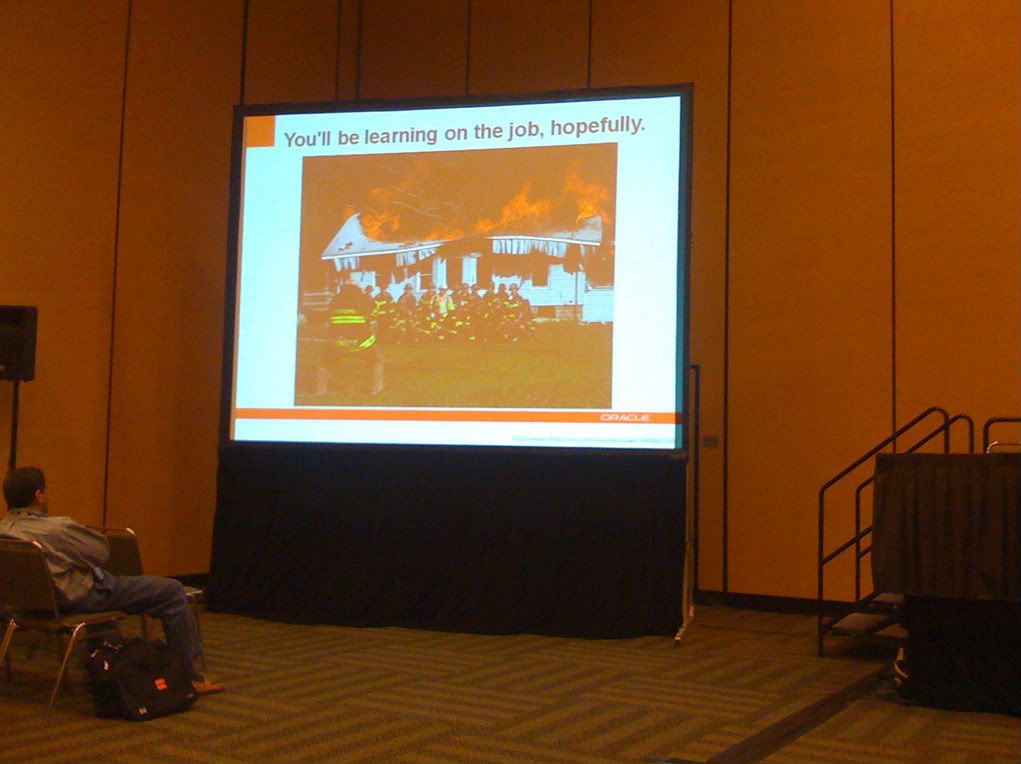
- Lots of posters around the conference about how "X Is Coming" on 9/24/08. No clue about what X is (maybe be something to do with the rumored database announcement?), but it'll be fun to hear what comes out on Wednesday.
- I've been peppered with people asking when and where I'm presenting the latest update on JPL's Roadmap to Fusion Applications. Unfortunately, the presentation did not "make the cut" for OOW this year. Given the feedback I've gotten today, I'll post some type of update here within the next few weeks.
- I've been infected with what Steven Chan calls "the halo effect." It's time to buy a new laptop and I've been so impressed with my iPhone that I'm thinking of switching from PC to Mac. There is an Apple store down the street that's been calling my name all week, so my OOW trip may turn out to be expensive indeed.
My schedule has been packed and the days have been long so far. I'm starting to feel a bit run down. Here's hoping some sleep will recharge the batteries.
Well, that's a summary of a very long, very active day. You can see today's pics here.
Monday, September 15, 2008
All Spruced Up
It's a sure sign that Oracle OpenWorld is at hand: the junk mail is pouring in, both email and snail mail. In the past, I really got some solid value out of the snail mail adds - I would save all that junk mail, wrap it up in really tight paper logs, and use them as firestarters in my fireplace over the winter. Now that I'm older and lazier, I just throw it all away...
I've put together my final schedule (well, final for the moment - things will certainly change as the conference progresses) and pretty much know where I'll be most of the time, although my Monday and Tuesday evening schedules are way overbooked. So now I'm pretty much all spruced up and ready for the Big Dance. I've got some sessions planned, some windows during each day for wandering around and talking to people (the best and most valuable part of any conference, IMHO), and some discussions to attend at the Unconference. In fact, the Unconference looks really strong this year; any time I find myself with a few open moments, I'll probably be at an Unconference session.
A few folks (like my boss) really like to know specifically which sessions I'll be attending at which particular time. Well, like I said, I have a plan. However, I'll very likely change it up quite a bit depending on how things go. If you really want to know where I'm at and what I'm doing, follow me on Twitter (my id is fteter). I'll be attempting to improve on my "Twitter slacker" challenge during OOW. I'll also be blogging from the conference at time permits, but my Twitter posts should be the closest thing to real time updates.
Six days left until I step off the plane in SFO on Sunday morning...looking forward to it! Hope to see you there.
So, what you think we'll see and hear at OOW this year? I have four announcements/events/activities/presentations I speculate ("speculate", as in I don't know diddly and have aboslutely no reliable info - I'm just guessing) will take place during OOW:
- An announced release or release date for E-Business 12.1
- A basic message for apps customers about using Fusion Middleware to extend your current Oracle applications
- An overview on how BEA and Hyperion components fit into and interact with the Oracle product family
- An announced release or release date for some early Fusion Apps, probably in the CRM space but not part of an integrated suite.
I'd really like to hear your guesses as well, so hit me in the comments.
Friday, August 29, 2008
Fusion Applications Seen Up Close
I took a day trip up the coast to Oracle HQ today. The purpose of the trip was to attend a special demo of Oracle Fusion Applications; a capstone to the Oracle Fusion Project Portfolio Management Design Validation project Oracle conducted with a small group of customers, including the Jet Propulsion Lab. I saw up close what will eventually evolve into Fusion Applications Version 1.0. Not a PowerPoint deck of slides, not non-functional or semi-functional prototypes, but the real honest-to-goodness applications. Not in a live production environment, but a live demo environment...akin to the "Vision" demo instance for the E-Business Suite. I witnessed execution of transactions, data input, and drill-downs from analytics into transactional detail. Some observations I made and conclusions I drew as a result of today's experience:
- Fusion Applications are real...period. If you read anything about "vaporware" or "not real" or "far from completion", recognize it for what it is...baloney. If I were numbering my iterations or versions prior to a 1.0 release, I'd put what I saw today at roughly about version 0.7 or 0.8 ...but that's strictly a rough, speculative guess on my part, and is definitely not the means by which the Fusion development team is tracking their progress (By the way, I have nothing to share on actual progress against plans or release dates. If I had it to share, I would...but I don't, so I won't. There's enough speculation on the release date and plans without me pouring any more fuel on the fire).
- Although the user interface is different from anything we've seen before, it's very intuitive. In addition, although the information presented through the user interface varies from application to applications, the manner in which the user interface works is fairly consistent across applications. It's definitely next-generation in terms of the way users will relate to the applications.
- There is a big emphasis on Web 2.0 concepts: easy collaboration and communication by enabling networking (instant chat and discussion boards across social and organizational boundaries, pushing out information (especially in the form of embedded analytics) you care about where you care about it, RSS feeds on changes and transactions (which allows a user to track activities in a browser without ever logging into Fusion Applications) and leveraging tagging of business objects to arrange data in all sorts of ways according to categories or groups that are important to you and your enterprise. I was especially astounded by the number of times during the day that I tied features in Fusion Applications to something from the Oracle AppsLab (things that Jake blogged on or Paul wrote about or "gee, that looks a lot like some of Rich's work from Oracle Mix" - somebody in Fusion Applications development must be watching what these guys do and share)...very cool to see the results of the synergy there. For example, users can graphically depict networks within and across organizational stovepipes (Fusion Applications refers to this as a "Social Mesh"), depicting who is working with who and what they're working on. As a project manager, where the success of my project often hinges on good communication between the right people to determine the right course of action, this functionality will be invaluable in identifying the right people for a given situation. Personally, I could use this functionality right now.
- Speaking of synergy, the synergy between the E-Business Suite, PeopleSoft, and Siebel is also very apparent, particularly in business processes and applications functionality. Although Fusion Applications is much more than a "conceptual mash-up" of Oracle's various applications product lines, it's obvious that the development team took the time to bring together the best features, processes, and lessons learned from the existing application product lines.
- One more important point I need to share out here: many users, including me, were under the impression that Fusion Applications will rely on a "pillar" database architecture (a concept from the PeopleSoft space that roughly equates to one database instance for each application in an application suite - one for HR, one for Projects, one for Financials, and so on). In fact, I've built a strategic plan for JPL's institutional business systems around this understanding. However, it turns out that it's not true. An upgrade from the E-Business Suite, which is based on a single database instance for all apps in the suite, to Fusion Applications will result in one database instance for Fusion Applications. However, EBS users can opt for a pillar architecture if desired. In additon, those organizations currently utilizing the pillar architecture will have the option to retain that architecture in an upgrade to Fusion Applications.
- After today's session, it's fairly obvious to me that Fusion Applications won't be for everyone. Progressive companies, agressive IT departments, collaborative enterprises, cutting edge organizations...they'll be the organizations best suited to drive value by leveraging the next-generation features of Fusion Applications.
- It's also fairly obvious to me that nobody should put their business and IT initiatives "on hold" to wait for Fusion Applications. Using Fusion Middleware to extend the functionality of your current applications not only will yield value in the present, it will also help your enterprise evolve toward readiness for Fusion Applications.
Subscribe to:
Posts (Atom)