Most people who know me professionally know about my enthusiasm for enterprise applications delivered via the SaaS model. In terms of adoption and agility, SaaS is a winner. But, at the same time, I also recognized that SaaS is not for everybody. Those who customize heavily and those who want to retain a higher level of control are probably better off with on-premise enterprise applications.
So I was happy to hear about Cliff Godwin, Oracle's Sr. VP of Applications Technology over the E-Business Suite, laying out a roadmap for the future of the E-Business Suite at the Collaborate 2015 conference. Not only did Mr. Godwin lay out plans for more incremental releases of EBS 12.2.x, he also shared the news about a future 12.3 release. One of the primary intents of the 12.3 release will be to take further advantage of in-memory technology.
I'm an EBS fan. Rock solid database model. Recently improved user experience. Delivers high operational efficiency. So I'm happy to hear that EBS will continue to evolve.
NOTE: I'm not at Collaborate 15...wish I was, but I'm not...so big thanks to dear friend Karen Brownfield for clueing me in on the news.
Showing posts with label #EBS. Show all posts
Showing posts with label #EBS. Show all posts
Monday, April 13, 2015


Friday, September 05, 2014
Nobody Bunts With Two Strikes
Once upon a time, I coached a young women's fast pitch softball team. Big adventure, as most of my coaching experience is with baseball, and I really enjoyed it. One game, the opposing team's catcher was hitting with two outs and two strikes. I shouted out to my team to stop covering the bunt - nobody bunts with two strikes (because a foul ball off a bunt attempt is strike three). So my team's infield draw back. Then the catcher bunts, laughing at me all as she jogs down to first base with a clean infield hit. Yeah, I ate some serious humble pie. And I learned to never bet on the past as an absolute limitation on possibilities for the present and future.
Today I know enterprise application developers who take the attitude that they've never had to worry about the user before, so why start now? Hold that thought for a moment...
I've really enjoyed the unfolding story at Infor. Their tag line is "Beautiful business software for your business processes." Infor has baked the concept of beautiful design into their corporate culture, even so far as to invest in design firm Hook and Loop to drive design as a part of their corporate culture. Infor actually considers design as a product and corporate differentiator. Seems to be working for them. $3B in annual revenue growing at a 40%+ clip is nothing to sneeze at. And I suspect a bit of that success comes from the emphasis on User Experience design brought to Infor by CEO and Oracle alum Charles Phillips.
Oracle? Yup. The UX team at Oracle has proven that user experience design is a differentiating factor in the marketplace. Simplified UI has played well with potential Fusion/Cloud customers. So well, in fact, that the E-Business Suite is now adopting Simplified UI. And the PeopleTools team seems to have enabled the adoption of many Simplified UI design patterns with the 8.54 release. And that UX team continues to innovate with improved user experiences (which is much more than just UI) utilizing Fusion Middleware.
Oracle, Infor, Workday, SAP...they've all embraced the concept (admittedly, some more than others) that beautiful design sells while not-so-beautiful design is a competitive hinderance.
Now, let's consider that thought again. "I've never had to worry about the user before, so why start now?" Yeah, and nobody bunts with two strikes.
Thoughts? Opinions? Find the comments.
Sunday, June 29, 2014
Changing My Lab
As we continue to see more inroads made by cloud and SaaS technology, I have to admit to a downside...what can I work with in my local lab.
My local lab consists of two iMacs, an Apple Airbook, several arrays of 1-TB external hard drives from OWC, and a serious effort in leveraging virtual machines (I'm personally a VMware fan). It wasn't too long ago that I could run most Oracle technology on my little lab platform. And I like it that way...I prefer to have total control over all my prototyping and development environments.
But as Oracle transitions to the cloud, the software footprint for the various Oracle technologies I work with has just become too big for my lab platform. Fusion Applications, the Business Process Management Suite, OBIEE, the SOA Suite...heck, even E-Business Suite 12.2.x is pushing the limit. Some of the footprint growth is due to new features, some to code bloat or technical debt, and some is just the nature of the beast with enterprise applications built for the cloud.
I'll also admit to being cheap here. There's no subscription fees for AWS or Oracle Cloud coming out of my personal wallet. Just not gonna happen. And investing in new hardware seems to be akin to stocking up on buggy whips or vacuum tubes.
So, what's my plan? My intent is to go back to basics for my home lab. I can still run an Oracle database quite nicely (anything ranging from Enterprise to APEX to Express). I can also run Oracle ADF (but, due to performance issues, I choose Glassfish over WebLogic). OBIEE sample apps also fit and run well. But I'll have to look to my company, my customer, or some other kind-hearted soul for bigger sandboxes - Fusion Apps or Middleware, OBIEE, and anything having to do with SOA integration or business process builds. I'm not crazy about this solution, but it is what it is...
What about the rest of you out there? How do you folks (especially the non-Oracle employees) handle your personal sandboxes these days? Any ideas or suggestions? Comments welcome.
Tuesday, April 22, 2014
Convergence
Convergence (\kən-ˈvər-jən(t)s\)
1 : the act of converging and especially moving toward union or uniformity; especially : coordinated movement of the two eyes so that the image of a single point is formed on corresponding retinal areas
2 : the state or property of being convergent
3 : independent development of similar characters (as of bodily structure of unrelated organisms or cultural traits) often associated with similarity of habits or environment
4 : the merging of distinct technologies, industries, or devices into a unified whole
"Convergence." Merriam-Webster.com. Merriam-Webster, n.d. Web. 22 Apr. 2014.
We're seeing convergence in process, right now, in Oracle's enterprise applications. Some examples:
Simplified UI: Take a look at Simplified UI in Fusion Applications Release 8. Then look again at the Simplified UI recently announced for the E-Business Suite. And then take another look at the new UI for PeopleSoft 9.2. They're all looking and working in a similar fashion. Built on different technologies, to be sure, but providing a similar user experience. Functional design patterns are driving a convergence in the user experience for Oracle's packaged applications.
Continuous Delivery: PeopleSoft uses a continuous delivery model - feature packs developed incrementally, then automatically distributed to end users for review and application in an incremental fashion. Not upgrades, but incremental enhancements of the existing version...which may eventually lead to the end of major upgrade events for PeopleSoft altogether. With online patching as of release 12.2, the E-Business Suite seems headed in the same direction. With Fusion on the cloud as SaaS, moving to a continuous delivery model is not a difficult matter (in fact, short of the branding of new releases and the perception that branding creates, Fusion Applications is already built on a continuous delivery model).
Cloud: The convergence here seems to be one of industry strategy. Commercial industries on cloud, public sector industries on cloud, and the recently announced clouds directed at the higher education space. Oracle is utilizing their basic cloud applications services, then supplementing with additional services built for specific industries. Again, the higher education market is the best example of this: Student Cloud, Higher Education Cloud, and new higher education specific functionality for Fusion Applications.
These are simply the most visible examples of the convergence trend taking place within Oracle's enterprise applications. There are more taking place, and I'm sure the future holds even more. We're barely at the beginning of this trend.
The real question here: what does this mean for the customers? IMHO, it's significant...but each customer will probably come up with different answers. Just some ideas to get the gears turning: co-existence between different Oracle applications with a single, consistent user experience; hybrid platforms running transactions on-premise, but with big data processed on the cloud to provide information through a combination of transactional reporting and embedded analytics; moving from teams supporting major upgrade efforts to small teams engaged in continuous delivery, thus freeing up more resources for important, strategically-oriented work.
That's all I can jam into this post without turning it into an epistle. Hopefully I've left you with your brain cells jiggling about what convergence within Oracle's enterprise applications means to you. Thoughts? Comments? You know what to do.
1 : the act of converging and especially moving toward union or uniformity; especially : coordinated movement of the two eyes so that the image of a single point is formed on corresponding retinal areas
2 : the state or property of being convergent
3 : independent development of similar characters (as of bodily structure of unrelated organisms or cultural traits) often associated with similarity of habits or environment
4 : the merging of distinct technologies, industries, or devices into a unified whole
"Convergence." Merriam-Webster.com. Merriam-Webster, n.d. Web. 22 Apr. 2014.
________________________________________________________
We're seeing convergence in process, right now, in Oracle's enterprise applications. Some examples:
Simplified UI: Take a look at Simplified UI in Fusion Applications Release 8. Then look again at the Simplified UI recently announced for the E-Business Suite. And then take another look at the new UI for PeopleSoft 9.2. They're all looking and working in a similar fashion. Built on different technologies, to be sure, but providing a similar user experience. Functional design patterns are driving a convergence in the user experience for Oracle's packaged applications.
Continuous Delivery: PeopleSoft uses a continuous delivery model - feature packs developed incrementally, then automatically distributed to end users for review and application in an incremental fashion. Not upgrades, but incremental enhancements of the existing version...which may eventually lead to the end of major upgrade events for PeopleSoft altogether. With online patching as of release 12.2, the E-Business Suite seems headed in the same direction. With Fusion on the cloud as SaaS, moving to a continuous delivery model is not a difficult matter (in fact, short of the branding of new releases and the perception that branding creates, Fusion Applications is already built on a continuous delivery model).
Cloud: The convergence here seems to be one of industry strategy. Commercial industries on cloud, public sector industries on cloud, and the recently announced clouds directed at the higher education space. Oracle is utilizing their basic cloud applications services, then supplementing with additional services built for specific industries. Again, the higher education market is the best example of this: Student Cloud, Higher Education Cloud, and new higher education specific functionality for Fusion Applications.
These are simply the most visible examples of the convergence trend taking place within Oracle's enterprise applications. There are more taking place, and I'm sure the future holds even more. We're barely at the beginning of this trend.
The real question here: what does this mean for the customers? IMHO, it's significant...but each customer will probably come up with different answers. Just some ideas to get the gears turning: co-existence between different Oracle applications with a single, consistent user experience; hybrid platforms running transactions on-premise, but with big data processed on the cloud to provide information through a combination of transactional reporting and embedded analytics; moving from teams supporting major upgrade efforts to small teams engaged in continuous delivery, thus freeing up more resources for important, strategically-oriented work.
That's all I can jam into this post without turning it into an epistle. Hopefully I've left you with your brain cells jiggling about what convergence within Oracle's enterprise applications means to you. Thoughts? Comments? You know what to do.
Saturday, March 22, 2014
Moving Forward
Seems to be quite a bit of buzz in the enterprise software user community these days about moving forward. Budgets have loosened up, users want better experiences, in-house IT providers want to reduce maintenance and infrastructure investments, C-level officers want better and more timely information on strategic initiatives, and everybody wants to be agile (even though there are multiple visions of agile, we all want it). So it seems the big question lately is "how do we move forward"?
Most of my posts lately sound like "blasts from the past"...you can probably add this post to that category. I'd recommend four things you can begin with right now in preparing to move forward:
If you're not on the latest release of PeopleSoft, Campus Solutions, E-Business Suite, or whatever packaged products you're using, get there. Doing so will assure that you have the best platform to move forward from, in addition to making most transitions substantially less complicated.
Another way to state this is is develop a description, in well-defined behavioral terms, for where you want your enterprise to be. Note that this is not a technical roadmap, but more of a business-oriented roadmap. Some considerations for that business roadmap may include:

Understand what assets you have on-hand that may help or hinder your way forward. Were it me, I'd want five categories of existing enterprise assets:
Customizations increase the cost of moving forward and extend the time required. That customizations list we built in step 3? Why do we have those customizations? Could we replace any of them with out-of-the-box functionality from shrink-wrapped applications? What about an extension to a packaged application? Do we still need the customization at all? Should we rebuild the customization on a new technology platform?
So, there ya go. Four things you can do today. No consulting services or special tools required. Just serious commitment on your part: get to the latest release of whatever you're using, describe your desired business end-state, catalog your enterprise assets and reconsider your customizations. The discussion doesn't change, regardless of the tech platform you're currently using.
We'll talk soon about what comes next. In the meantime, share your thoughts in the comments...and get busy!
1. Move To The Latest Applications Release
2. Prepare A Business Roadmap For Moving Forward
3. Inventory Your Enterprise Assets
- Business processes
- Applications (custom and packaged)
- Information (including both what we have and what we share with whom - they're different!)
- Projects
- Customizatons
4. Reconsider your customizations
So, there ya go. Four things you can do today. No consulting services or special tools required. Just serious commitment on your part: get to the latest release of whatever you're using, describe your desired business end-state, catalog your enterprise assets and reconsider your customizations. The discussion doesn't change, regardless of the tech platform you're currently using.
We'll talk soon about what comes next. In the meantime, share your thoughts in the comments...and get busy!
Friday, March 07, 2014
A Crazy Game Of Poker, Verse 2
A few months ago, I announced my resignation from EiS Technologies ("A Crazy Game Of Poker"). Another one of those leaps of faith - agreeing to part months ahead of time, not quite knowing where I was going next. It's a great approach to parting ways with an employer if all parties can step up to behaving like grown-ups. It gives the employer time to find and train a replacement as well as picking your brain for knowledge transfer, and it gives the employee time to search for the next gig without facing huge financial pressures. It works well as long as all parties are mature enough to refrain from any vindictive behavior.
Big kudos to the leadership at EiS for stepping up through this time period and making it all work well. EiS is a special place with a special team...I miss every bit of it.
I started a new adventure with Io Consulting in February. I like the social value of the company's mission: 100% Oracle, 100% Higher Education, 100% Customer Satisfaction. Each and every one of those elements are important to me. My role will be building up Fusion Middleware and Oracle Cloud Applications Services capabilities within the company. So I'll continue to be deeply involved in User Experience, ADF, and the overall Fusion/Cloud Applications architecture. I'll likely get into some PeopleSoft & Campus Solutions areas as well...it's been awhile since I've been intimately involved in either, so it'll be nice to get back there again. So I'm very excited to join the Io Consulting team and look forward to what lies ahead.
In some ways, it will be weird: no more Collaborate or KScope, a little less emphasis on EBS, a more narrowly focused customer set. But I'll get to attend Alliance on a regular basis (rather than the sporadic attendance of the last five years) and I'll still be a regular at OOW. And the new management team uses the word "cool" on a regular basis, so that's a good indicator. And I get to work with Ted Simpson - it gets no better than that!
OK, I'm done being self-centered now. The next post will take us back to our regularly scheduled programming.
Monday, February 24, 2014
Getting Lucky
Every once in awhile, I get lucky. Out of the clear blue sky, life tosses me a bone…or a gold nugget…or a diamond. We’re speaking figuratively, of course. I’m not much for bones unless it’s in the middle I’m BBQing. Gold and diamonds…yeah, I’m not THAT lucky. But I digress.
Aidan Duffy recently sent me an e-copy of his book, “The Oracle Opportunity: The Blueprint To Succeeding As An Oracle EBusiness Consultant.” For those of you who don’t have the pleasure of knowing Aidan, he has been successfully delivering Oracle EBS implementation projects throughout Europe for the past 20 years. Clients include Pfizer, General Electric, Canon, Alcatel-Lucent and Diageo.
Aidan’s book is not another “learn Oracle EBS” manual. “The Oracle Opportunity” lays out a roadmap for becoming a successful EBS consultant, based on Aidan’s experiences. For those of you who have wondered about making the transition from employee to consultant, this book is for you. If you’re already in the EBS consulting field, this book is a great refresher for succeeding as a consultant.
In the book, Aidan explains how to build your own consulting career using four pillars: Position Yourself, Package Your Experience, Promote Yourself and Partner With The Right People. Aidan further explains how to build up your four pillars through a 12-step plan. Well worth the read.
Had I possessed Aidan’s book 20 years ago, it would have saved boatloads of time and trouble. Aidan captured many things I’ve had to learn from “The School of Hard Knocks”. But it just wasn’t my time to get lucky. But your time could be now…
You can find out more at www.iloveoracle.com or on Twitter @aidanjduffy. Or you can grab the book off Amazon here.
Monday, December 09, 2013
Past Discoverer...And Beyond!
Apologies to all you Buzz Lightyear fans for the title...
If you pay any attention to the Oracle enterprise applications space, you’re likely aware of the fuss being raised over the impending demise of Oracle Discoverer. Discoverer is a pretty nifty ad hoc reporting tool used for both enterprise applications and in “home grown” data applications. It’s been a pretty good tool when used properly.
The thing is, Discoverer has been around for a very long time. And, in all honesty, it just doesn’t play well with the other components in Oracle Fusion Middleware (“FMW”). As FMW continues to evolve and progress, Discoverer has unfortunately become a casualty of that evolution and progression. While you don’t want to stop the continued improvement of FMW over a single component, the sunsetting of Discoverer does leave Oracle customers in a bit of a pickle moving forward in regards to handling ad hoc transactional reporting. With that pickle in mind, let’s take a look at your options moving forward:

And a few notes to supplement the table of options:
1. I’m not planning to discuss the legitimacy of the fuss over the sunsetting of Discoverer here. You can check it for yourself at Page 8, Line Item 9 in the Oracle Lifetime Support document for Fusion Middleware at http://www.oracle.com/us/support/library/lifetime-support-middleware-069163.pdf.
2. Oracle’s recommended path is for Discoverer users to leverage Oracle Transactional Business Intelligence, which is part of the Oracle Business Intelligence Enterprise Edition platform.
3. Feedback from those using DOMA indicated that only the simplest of Discoverer workbooks will convert automatically. Most require significant manual assistance.
So what’s the upshot of this blog post? So that you can be informed and begin to prepare for the change. While it’s not time to panic by any means, it is time to get ready: consider your options, lay out your roadmap, then execute against that roadmap. Discoverer is sunsetting. What’s your plan?
If you pay any attention to the Oracle enterprise applications space, you’re likely aware of the fuss being raised over the impending demise of Oracle Discoverer. Discoverer is a pretty nifty ad hoc reporting tool used for both enterprise applications and in “home grown” data applications. It’s been a pretty good tool when used properly.
The thing is, Discoverer has been around for a very long time. And, in all honesty, it just doesn’t play well with the other components in Oracle Fusion Middleware (“FMW”). As FMW continues to evolve and progress, Discoverer has unfortunately become a casualty of that evolution and progression. While you don’t want to stop the continued improvement of FMW over a single component, the sunsetting of Discoverer does leave Oracle customers in a bit of a pickle moving forward in regards to handling ad hoc transactional reporting. With that pickle in mind, let’s take a look at your options moving forward:

And a few notes to supplement the table of options:
So what’s the upshot of this blog post? So that you can be informed and begin to prepare for the change. While it’s not time to panic by any means, it is time to get ready: consider your options, lay out your roadmap, then execute against that roadmap. Discoverer is sunsetting. What’s your plan?
Tuesday, November 26, 2013
Crazy Game Of Poker
Who's up for game two
What to do
My wallet's gettin thin
And I just lost my watch last night
Well I gotta problem
Just one answer
Gotta throw it all down
And kiss it goodbye
Yeah!
What to do
My wallet's gettin thin
And I just lost my watch last night
Well I gotta problem
Just one answer
Gotta throw it all down
And kiss it goodbye
Yeah!
That was a crazy game of poker
(That was a crazy game of poker)
I lost it all
(I lost it all)
But someday I'll be back again
And I, never to fold.
(Never to fold)
(That was a crazy game of poker)
I lost it all
(I lost it all)
But someday I'll be back again
And I, never to fold.
(Never to fold)
- From O.A.R.’s “That Was A Crazy Game Of Poker”
I try not to be too self-centered here, because I’m pretty convinced you don’t want to read that kind of tripe. But it’s been a crazy game of poker for the past few days, so I thought I’d share a little bit on here.
First - LinkedIn Went Crazy
I was touching up my LinkedIn profile over the weekend and changed the title of my current job from “Executive Vice President” to “EVP” (more on that in a second). LinkedIn interpreted that as a new job and the congrats have been pouring in since. Digging all the good will, but nothing really happened.
Second - Accolades From Forbes
Earlier this week, Forbes designated my humble Twitter feed as one all Oracle users should read. Wow. I’m honored, especially when I look at the other folks on the list. Grateful to be included as part of that crowd. Pretty doggone cool. So, if Forbes has enticed your interest, it’s twitter.com/fteter.
Third - I Resigned From EiS Technologies
Yup, I resigned from my current job at EiS Technologies effective December 31. Now you know why I was tweaking my LinkedIn profile over the weekend ;) And I don't even know here I'm going next. Now why would I do a dumb thing like that?

Tuesday, October 08, 2013
Oracle EBS 12.2.2 Fresh Install - Done
I've finished the fresh install of an Oracle EBS 12.2.2 Vision instance in my test environment (install 12.2 and then apply the 12.2.2 RUP). Strictly vanilla, no customizations. I'll be doing the validation testing to make sure everything is functional when I get back from this week's business trip.
My original plan was to lay out the entire install step-by-step for all of you. However, the way things turned out, it would be a little dishonest if I did. A couple of other folks have already done most of the work here, and I relied heavily on their experiences in my own install. So, rather than "borrowing" or replicating what they wrote, let's just give credit where credit is due...along with a "thank you".
I've listed the great reference docs from Oracle in my prior post on this subject, so I'll focus here on material from non-Oracle employees - I could not have finished without their contributions:
I'm sure I'll have some observations to share as I continue to test my install, and I'll be sure to share them here. In the meantime, check the Oracle reference docs as well as the blog posts from John and Atul before you try this. And keep in mind that it went well for me, so it can't be all that difficult, right?
My original plan was to lay out the entire install step-by-step for all of you. However, the way things turned out, it would be a little dishonest if I did. A couple of other folks have already done most of the work here, and I relied heavily on their experiences in my own install. So, rather than "borrowing" or replicating what they wrote, let's just give credit where credit is due...along with a "thank you".
I've listed the great reference docs from Oracle in my prior post on this subject, so I'll focus here on material from non-Oracle employees - I could not have finished without their contributions:
- Pythian's John Piwowar provides some great preparation notes for installing a 12.2 Vision instance here.
- The Online Apps DBA, Atul Kumar, walks in detail through both the preparation and the install of EBS 12.2 here and here.
I'm sure I'll have some observations to share as I continue to test my install, and I'll be sure to share them here. In the meantime, check the Oracle reference docs as well as the blog posts from John and Atul before you try this. And keep in mind that it went well for me, so it can't be all that difficult, right?
Monday, September 30, 2013
EBS 12.2.2 - First We Read
As I work through the EBS 12.2.2 fresh install, I'm focusing in on details. Hoping that doing so will add more value to those of you out there about to dive in for yourself.
So, the first step: reading. Yup, back away from the groovy technical stuff and great ready to make like a virtual sponge, soaking up lots of info. The docs you'll want to read before you even think about planning the install (listed in no particular order):
So, if I don't post for the next few days, rest assured it's because I'm reading...and re-reading...and reading again in the attempt to soak all this information up.
SIDE NOTE: I was asked earlier today to provide a source for my estimates regarding disk space and to provide an estimate to disk space growth for a "typical" upgrade from 12.1.3 to 12.2.2. A few points to be made here:
UPDATE: And then we read a little more. The EBS 12.2 Information Center came up on My Oracle Support earlier today. Doc 1581299.1. Add this to your list of critical reference docs.
So, the first step: reading. Yup, back away from the groovy technical stuff and great ready to make like a virtual sponge, soaking up lots of info. The docs you'll want to read before you even think about planning the install (listed in no particular order):
- The EBS 12.2.0 Installation Guide: Rapid Install
- Doc 1506669.1 Oracle E-Business Suite Release 12.2.2 Readme
- Doc 1320300.1 Oracle E-Business Suite Release Notes, Release 12.2
- Doc 1376487.1 Oracle E-Business Suite Applications DBA (AD) Release Notes for Release 12.2.2
- Doc 1330701.1 Oracle E-Business Suite Installation and Upgrade Notes Release 12 (12.2) for Linux x86-64 (note the 702, 703 and 704 versions for other operating systems)
- Doc 1355068.1 Oracle E-Business Suite 12.2 Patching Technology Components Guide
- Doc 1155883.1 Oracle E-Business Suite Desktop Client Hardware and Software Requirements
- Doc 389422.1 Recommended Browsers for Oracle E-Business Suite Release 12
- Doc 1560906.1 Applying the Release 12.2.2 AD and TXK Release Update Packs
- Doc 1314621.1 Oracle E-Business NLS Release Notes, Release 12.2
- Doc 1376618.1 Oracle E-Business Technology Stack Release Notes for Release 12.2.2
- Doc 1469456.1 Datainstall and HRGlobal Application 12.2 Specifics
So, if I don't post for the next few days, rest assured it's because I'm reading...and re-reading...and reading again in the attempt to soak all this information up.
SIDE NOTE: I was asked earlier today to provide a source for my estimates regarding disk space and to provide an estimate to disk space growth for a "typical" upgrade from 12.1.3 to 12.2.2. A few points to be made here:
- Estimates on a "typical" implementation of any type of technology give me a sick feeling in the pit of my stomach. There is no such thing as "typical" in the tech world...every implementation is a bit different. I worry about providing bad guidance. But, for those who insist on knowing, my "worst case" planning yardstick on upgrading from any EBS dot release to the next one is 20 percent database growth. Also keep in mind that, with the new file system and on-line patching technology, you're likely to chew up a pretty significant amount of extra disk space. Disk space is cheap, no sense in not buying long here.
- My source for planning any type of upgrade is the latest upgrade doc. For 11i to 12.2 requirements (and lots of other useful info), see the Oracle E-Business Suite Upgrade Guide: 11i to 12.2.; Check pages 1-11 through 1-13 for good minimum starting points.
UPDATE: And then we read a little more. The EBS 12.2 Information Center came up on My Oracle Support earlier today. Doc 1581299.1. Add this to your list of critical reference docs.
Monday, July 22, 2013
A Little Help From My Friends
Oh, I get by with a little help from my friends
Mmmm, I get high with a little help from my friends
Mmmm, I'm gonna try with a little help from my friends
- From "With A Little Help From My Friends", Lennon and McCartney
One of the great highs about the software business…I make a ton of friends. And those friends are really, really smart. Most far smarter than me. And those far smarter friends are very generous in sharing what they know.
Case in point; a swell little package showed up in the mail last week. Pal Mike Swing at TruTek sent me a complimentary copy of his latest book: "The Little R12.1.3 Tuning and Troubleshooting Guide". Written for Oracle E-Business users, Mike's book hones in on performance tips and common issues/solutions for an EBS 12.1.3 upgrade.
Love the way this book is laid out…light on fluff, heavy on usable content. Mike works through all the administrative and introductory stuff (Table of Contents, Preface, Copyright, etc.) in the first 14 pages. Then he dives straight into the meat: 31 snippets of content on 31 basic performance tips related to your 12.1.3 upgrade. My personal favorite is Tip #16 on understanding CPU and I/O Utilization. I grapple with CPU and I/O performance issues - a lot! Years of blood, sweat and tears. Mike pretty well lays it out in nine pages. Really? How can anybody explain this stuff in nine pages??? Mike not only does it, but I personally learned a boatload by reading it.
Once Mike wraps up with the performance tips, he adds on an added bonus: troubleshooting tips for the 24 most common technical issues encountered in a 12.1.3 upgrade. How to recognize those issues, how to troubleshoot to determine root cause, and what to do about the root cause after you've identified it.
I'll be bugging Mike for a PDF version of this book, as I want it in my iPad reference materials.
Love it when I get a little help from my friends. You can find out more about Mike's book here.
Friday, March 29, 2013
Grooving on EBS
It's been some time since I wrote much here about Oracle's E-Business Suite. It's not that I don't like the EBS Suite, because I really do. I've just been focused on other things.
Sometimes, when you're distracted, somebody will put out something so nifty that you're forced to refocus. The Oracle EBS folks have done that to me with a new YouTube channel dedicated to EBS. Lots of good stuff here. The channel might even provide some tidbit you'll want to dig deeper into at Collaborate 13. So check it out and spend some time grooving on EBS.
Sometimes, when you're distracted, somebody will put out something so nifty that you're forced to refocus. The Oracle EBS folks have done that to me with a new YouTube channel dedicated to EBS. Lots of good stuff here. The channel might even provide some tidbit you'll want to dig deeper into at Collaborate 13. So check it out and spend some time grooving on EBS.
Wednesday, March 27, 2013
EiS at Collaborate 13
With Collaborate 13 on the near horizon, I'm hearing quite a bit of "Hey Floyd, what's EiS doing at Collab 13?"...the short answer is that we have a pretty significant presence at the conference. Here's the long answer:

Hey, you can't be an Oracle Partner and not have a booth at a conference, right? So, we have a booth. I'll even be hanging out there a bit myself. So, if you want to see some cool reporting and BI products to compliment Oracle products...including the new Splash BI...come by and see us in Booth #1121. We'll have the well-known Treasure Chest going as well as a drawing for an iPad 3. And, besides all that, we can talk at "da booth". Speaking of having a conversation...if you mention @eistechnologies in a tweet, we'll give you a free two-day reporting assessment.
See ya'all in Denver.
Sessions

Da Booth
Hey, you can't be an Oracle Partner and not have a booth at a conference, right? So, we have a booth. I'll even be hanging out there a bit myself. So, if you want to see some cool reporting and BI products to compliment Oracle products...including the new Splash BI...come by and see us in Booth #1121. We'll have the well-known Treasure Chest going as well as a drawing for an iPad 3. And, besides all that, we can talk at "da booth". Speaking of having a conversation...if you mention @eistechnologies in a tweet, we'll give you a free two-day reporting assessment.
See ya'all in Denver.
Wednesday, March 20, 2013
Collaborate 13 Teaser
Those of you who follow either this blog or my Twitter account (@fteter) know that I've been up to my eyeballs in new product development over the past three or four months. You know that I've been using ADF Essentials in building that product. You also know that my team at EiS Technologies is planning to roll out the new product on a Controlled Availability Release basis at Collaborate 13.
A few notes on the overall experience:
Time for me to shut up now and let the product speak for itself. Here is a landing page screen shot from our latest iteration.
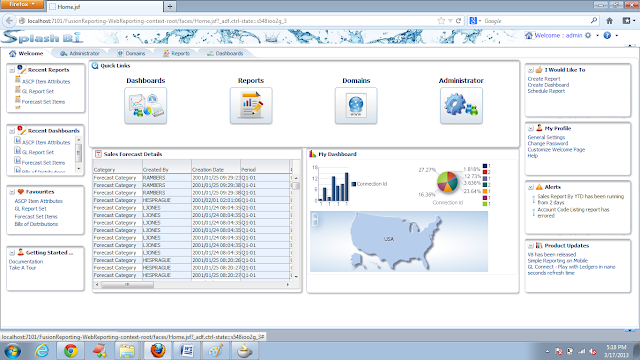
Take a look. Zoom in. Blow up the screen shot. Leave first impressions in the comments.
A few notes on the overall experience:
- ADF Essentials has not only performed better than advertised, it's changed our development team's thinking about how applications are developed.
- Thanks to ADF Essentials, we've built this product from scratch in under four months.
- The ADF Design Patterns, the ADF Rich Client User Interface Guidelines and the UX Direct tools were huge enablers in increasing productivity and cutting development cycle time.
Time for me to shut up now and let the product speak for itself. Here is a landing page screen shot from our latest iteration.

Take a look. Zoom in. Blow up the screen shot. Leave first impressions in the comments.
Thursday, December 06, 2012
ADF Essentials on Tomcat
I wrote the other day that I was doing some cool tech stuff, and I promised to update ya'all on my progress. Well, here we go.
As a non-techie functional type, I'm rather proud of myself from successful bringing up Oracle ADF Essentials on an Apache Tomcat web server and MySQL database. And I must give kudos here to Oracle Brazil's Raphael Rodrigues, who laid out a great set of instructions here.
I've tested this configuration out on various operating systems: Linux (Oracle, CentOS, Fedora, Ubuntu), Unix (OpenSolaris), Windows (XP, 7) and even...gulp...Apple's Mountain Lion (which is really Unix BeOS with some snazzy development thrown into the mix). All worked on my test beds.
Now, why would I go through all the trouble of doing this? Well, there are a few reasons:
1. As an E-Business User, I now have the opportunity to build ADF Rich Faces - based customizations in EBS 12.1.3 and externalize those customizations. In fact, I can even persistently externalize any data attribute customizations involved in those customizations in MySQL. And, if I'm really at the top of my game, I can use SOAP or REST integration to loosely-couple those integrations with EBS so the customizations survive any upgrades. Wow, maybe I can even get this to integrate with SaaS-based applications somewhere down the line?
2. Ditto for Fusion Applications.
3. Ditto for existing data warehouses.
4. Just as important as items 1-3 here...it was educational and fun!!!
More coming, as this is just the first increment in a much larger project. Questions? Thoughts? Jump on the comments.
Tuesday, August 28, 2012
OOW 2012 - Crystal Ball
I wonder what tomorrow has in mind for me
Or am I even in it's mind at all
Perhaps I'll get a chance to look ahead and see
Soon as I find myself a crystal ball
-- From Styx's Crystal Ball, Written by Tommy Shaw
Been asked a bunch lately about what new announcements & news I expect to hear from Oracle at Oracle OpenWorld next month. It's fun to prognosticate, even though I'm really, really bad at it. So, in the spirit of fun:
1. E-Business Suite: we'll see a pre-release demo and announcement. Emphasized points will be WebLogic and hot patching. My guess is we'll see GA in early 2013.
2. Fusion Applications: 3 announcements/demos:
4. Exasomethingorother: Do you really think we'll get through OOW without another hardware announcement of some sort?
5. Smurfvitdatasoc.com acquisition: At least one announcement of a company nobody has ever heard of who possesses technology that, when integrated into the Oracle product family, will forever change the way we do things.
So, now you have my predictions...including my humorous potshots on hardware and acquisitions. Keep in mind that my track record for predicting release dates is atrocious. So, anybody have any thoughts or anything to add? Hit the comments.
UPDATE (8/29/12): Silly me, I forgot to mention that we'll hear some cloud-related announcements other than SaaS for Fusion Apps [insert forehead slap here]. We'll hear tons about social and the cloud. In fact, I suspect OOW will be a real cloudapalooza.
Or am I even in it's mind at all
Perhaps I'll get a chance to look ahead and see
Soon as I find myself a crystal ball
-- From Styx's Crystal Ball, Written by Tommy Shaw
Been asked a bunch lately about what new announcements & news I expect to hear from Oracle at Oracle OpenWorld next month. It's fun to prognosticate, even though I'm really, really bad at it. So, in the spirit of fun:
1. E-Business Suite: we'll see a pre-release demo and announcement. Emphasized points will be WebLogic and hot patching. My guess is we'll see GA in early 2013.
2. Fusion Applications: 3 announcements/demos:
- We'll hear about a major release (likely won't call it 2.0, but that's essentially what it is) with a significant expansion in functionality. Project Portfolio Management functional reach will be greatly expanded. Again, a pre-announcement. GA? Around Dec. 2012.
- The entire Fusion Applications Suite on SaaS. The pricing scheme? Not likely. But at least GA for Fusion Apps on SaaS.
- An offering centered around important or core Fusion Applications business processes on SaaS. Probably rebranded, trimmed-down, and aimed at SME subscribers.
4. Exasomethingorother: Do you really think we'll get through OOW without another hardware announcement of some sort?
5. Smurfvitdatasoc.com acquisition: At least one announcement of a company nobody has ever heard of who possesses technology that, when integrated into the Oracle product family, will forever change the way we do things.
So, now you have my predictions...including my humorous potshots on hardware and acquisitions. Keep in mind that my track record for predicting release dates is atrocious. So, anybody have any thoughts or anything to add? Hit the comments.
UPDATE (8/29/12): Silly me, I forgot to mention that we'll hear some cloud-related announcements other than SaaS for Fusion Apps [insert forehead slap here]. We'll hear tons about social and the cloud. In fact, I suspect OOW will be a real cloudapalooza.
Subscribe to:
Posts (Atom)