Geek Warning: The Golden Path is a term in Frank Herbert's fictional Dune universe referring to Leto II Atreides's strategy to prevent humanity's ultimate destruction.
Just back from a little "stay-cation". My batteries were running a little low, so it was good to recharge for a bit. The #Beat39 theme continued to roll around in my brain and I want to share a predominant line of thinking from that.
Back in the olden days when Oracle was first developing Fusion Applications, they made a big effort to discover common threads of business practices across a range of industries and organizations. Processing invoices, controlling inventory, managing employee performance reviews, completing projects, billing customers...it's a long list of common business practices and common activities.
The result of that effort was a set of common "best practices", by industry, that were baked into Fusion Applications. That collection of best practices became known as the Oracle Business Process Model ("Oracle BPM"). You can see an example for the Project Portfolio Management Suite here. As Fusion Applications have evolved into Oracle Cloud Application Services (Oracle's SaaS offerings), Oracle BPM has evolved right along with it. You'll find the latest Oracle BPM in Oracle SaaS.
Back in the really olden days, customers and their implementation partners would generally follow a three-step implementing strategy: 1) understand the customer's current business process; 2) design the customer's future business process; 3) implement enterprise software to model the customer's future business process as closely as possible.
With today's SaaS applications, customers may be better served by following a different strategy: 1) configure a SaaS zone and test the "baked in" business processes with an eye toward utilizing those processes in your own organization; 2) address and resolve any business process gaps; 3) test and go live. In short, maximize your use of enterprise software in the way the software was designed to be used, business processes and all. Being open to business process change is the "Golden Path" to a successful SaaS implementation.
While this idea is nothing new, it's a pretty fundamental shift in perspective. Thoughts? Comments welcome.
Showing posts with label #FusionApps. Show all posts
Showing posts with label #FusionApps. Show all posts
Monday, August 31, 2015


Monday, January 19, 2015
Enterprise Apps on SaaS
It's really, really early on a Monday morning as I write this: "zero dark-thirty". Some ideas just refuse to allow sleep until you share them. So, while shivering in the pre-dawn cold, I offer the following for your consideration...
Picture if you will, just for a moment, the idea that your enterprise applications system is like an iceberg. There are the system costs that you can see. Then there are the costs below the water line, those that you can't quite see. Well, at least those nobody talks about when selling you an enterprise system.
Hanging with the iceberg simile, this is your IT system:

This is your enterprise applications system on SaaS:

Any questions?
Picture if you will, just for a moment, the idea that your enterprise applications system is like an iceberg. There are the system costs that you can see. Then there are the costs below the water line, those that you can't quite see. Well, at least those nobody talks about when selling you an enterprise system.
Hanging with the iceberg simile, this is your IT system:
This is your enterprise applications system on SaaS:
Any questions?
Thursday, August 21, 2014
Adapt - Learn New Things
Nothing lasts forever. Sand-piles crumble. Companies rise and fall. Relationships change. Markets come and go. It’s just the nature of things. Adapt or die. Personally, I like this feature of life…can’t imagine anything worse than stagnation. There’s nothing better to me than exploring and learning new things.
As Oracle continues their push into cloud-based enterprise applications, we’re seeing some of that fundamental change play out in the partner community; with both partner companies and with the individuals who make up the partners. This is especially true with the technology-based services partners. Companies have merged or faded away. Individuals, many of whom have stellar reputations within the partner and customer communities, have accepted direct employment with Oracle or moved into other technology eco-systems.
Why the big change? Frankly, it’s because the cloud doesn’t leave much room for the traditional offerings of those technology-based services partners. As we shift from on-premise to cloud, the need for those traditional offerings are drying up. Traditional installations, patching, heavy custom development…all those things seem headed the way of the buggy-whip in the enterprise applications space. It’s time to adapt.
As a guy involved in providing services and complimentary products myself, I’ve watched this change unfold over the past few years with more than a little self-interest and excitement - hey, ya gotta pay the bills, right? As a result, I’ve identified three adaptation paths for individuals involved with services in the Oracle technology-based eco-system:
1. Leave. Find another market where your skills transfer well and take the leap. This isn’t a bad option at all, especially if you’ve developed leadership and/or “soft skills”. Believe it or not, there’s a big world outside the Oracle eco-system.
2. Play the long tail. The base of traditional, on-premise work will not disappear over night. It’s shrinking, granted, but it’s a huge base even while shrinking. I also think there will be a big uptick in small, lightweight projects with traditional footprints that will compliment large cloud-based enterprise application systems (for further information, see “Oracle Apex”).
3. Learn new things. Apply your background to build skills in new technologies. If you’re an Oracle DBA or systems administrator (two skillets that are rapidly merging into one), dig into Oracle Enterprise Manager…and remember that private clouds will continue to flourish with Oracle’s larger customers. If you’re a developer, begin building skills in middle-tier integration - connecting cloud offerings in new and creative ways is very much an in-demand skill. Or get smart with building light-weight complimentary applications (ADF, BPM, SOA) - especially mobile (MAF). If you’re a business analyst or functional type, get familiar with Functional Setup Manager and the Oracle Composers. Maybe get a solid understanding of User Experience and how you can apply UX in your job. As a solution architect, I’ve spent a great deal of time learning how the various Oracle Cloud solutions work together from data, integration, business process, and information perspectives…and if I can do it, so can you!
Obviously, my approach has been to explore and learn new things relevant to the market changes. The opportunities I saw for myself consisted of connecting things together and adding value around the edges. It’s been a hoot so far and I’m nowhere near done yet. YMMV.
With Oracle OpenWorld coming up as a huge opportunity to learn new things, it seemed timely to share these thoughts now. So there you have it. My worm’s eye view of how the Oracle partner market (or at least the Oracle technology-based services partner market) is changing. Maybe I nailed it. Maybe I’m all wet. Either way, let me know what you think.
With Oracle OpenWorld coming up as a huge opportunity to learn new things, it seemed timely to share these thoughts now. So there you have it. My worm’s eye view of how the Oracle partner market (or at least the Oracle technology-based services partner market) is changing. Maybe I nailed it. Maybe I’m all wet. Either way, let me know what you think.
Tuesday, April 22, 2014
Convergence
Convergence (\kən-ˈvər-jən(t)s\)
1 : the act of converging and especially moving toward union or uniformity; especially : coordinated movement of the two eyes so that the image of a single point is formed on corresponding retinal areas
2 : the state or property of being convergent
3 : independent development of similar characters (as of bodily structure of unrelated organisms or cultural traits) often associated with similarity of habits or environment
4 : the merging of distinct technologies, industries, or devices into a unified whole
"Convergence." Merriam-Webster.com. Merriam-Webster, n.d. Web. 22 Apr. 2014.
We're seeing convergence in process, right now, in Oracle's enterprise applications. Some examples:
Simplified UI: Take a look at Simplified UI in Fusion Applications Release 8. Then look again at the Simplified UI recently announced for the E-Business Suite. And then take another look at the new UI for PeopleSoft 9.2. They're all looking and working in a similar fashion. Built on different technologies, to be sure, but providing a similar user experience. Functional design patterns are driving a convergence in the user experience for Oracle's packaged applications.
Continuous Delivery: PeopleSoft uses a continuous delivery model - feature packs developed incrementally, then automatically distributed to end users for review and application in an incremental fashion. Not upgrades, but incremental enhancements of the existing version...which may eventually lead to the end of major upgrade events for PeopleSoft altogether. With online patching as of release 12.2, the E-Business Suite seems headed in the same direction. With Fusion on the cloud as SaaS, moving to a continuous delivery model is not a difficult matter (in fact, short of the branding of new releases and the perception that branding creates, Fusion Applications is already built on a continuous delivery model).
Cloud: The convergence here seems to be one of industry strategy. Commercial industries on cloud, public sector industries on cloud, and the recently announced clouds directed at the higher education space. Oracle is utilizing their basic cloud applications services, then supplementing with additional services built for specific industries. Again, the higher education market is the best example of this: Student Cloud, Higher Education Cloud, and new higher education specific functionality for Fusion Applications.
These are simply the most visible examples of the convergence trend taking place within Oracle's enterprise applications. There are more taking place, and I'm sure the future holds even more. We're barely at the beginning of this trend.
The real question here: what does this mean for the customers? IMHO, it's significant...but each customer will probably come up with different answers. Just some ideas to get the gears turning: co-existence between different Oracle applications with a single, consistent user experience; hybrid platforms running transactions on-premise, but with big data processed on the cloud to provide information through a combination of transactional reporting and embedded analytics; moving from teams supporting major upgrade efforts to small teams engaged in continuous delivery, thus freeing up more resources for important, strategically-oriented work.
That's all I can jam into this post without turning it into an epistle. Hopefully I've left you with your brain cells jiggling about what convergence within Oracle's enterprise applications means to you. Thoughts? Comments? You know what to do.
1 : the act of converging and especially moving toward union or uniformity; especially : coordinated movement of the two eyes so that the image of a single point is formed on corresponding retinal areas
2 : the state or property of being convergent
3 : independent development of similar characters (as of bodily structure of unrelated organisms or cultural traits) often associated with similarity of habits or environment
4 : the merging of distinct technologies, industries, or devices into a unified whole
"Convergence." Merriam-Webster.com. Merriam-Webster, n.d. Web. 22 Apr. 2014.
________________________________________________________
We're seeing convergence in process, right now, in Oracle's enterprise applications. Some examples:
Simplified UI: Take a look at Simplified UI in Fusion Applications Release 8. Then look again at the Simplified UI recently announced for the E-Business Suite. And then take another look at the new UI for PeopleSoft 9.2. They're all looking and working in a similar fashion. Built on different technologies, to be sure, but providing a similar user experience. Functional design patterns are driving a convergence in the user experience for Oracle's packaged applications.
Continuous Delivery: PeopleSoft uses a continuous delivery model - feature packs developed incrementally, then automatically distributed to end users for review and application in an incremental fashion. Not upgrades, but incremental enhancements of the existing version...which may eventually lead to the end of major upgrade events for PeopleSoft altogether. With online patching as of release 12.2, the E-Business Suite seems headed in the same direction. With Fusion on the cloud as SaaS, moving to a continuous delivery model is not a difficult matter (in fact, short of the branding of new releases and the perception that branding creates, Fusion Applications is already built on a continuous delivery model).
Cloud: The convergence here seems to be one of industry strategy. Commercial industries on cloud, public sector industries on cloud, and the recently announced clouds directed at the higher education space. Oracle is utilizing their basic cloud applications services, then supplementing with additional services built for specific industries. Again, the higher education market is the best example of this: Student Cloud, Higher Education Cloud, and new higher education specific functionality for Fusion Applications.
These are simply the most visible examples of the convergence trend taking place within Oracle's enterprise applications. There are more taking place, and I'm sure the future holds even more. We're barely at the beginning of this trend.
The real question here: what does this mean for the customers? IMHO, it's significant...but each customer will probably come up with different answers. Just some ideas to get the gears turning: co-existence between different Oracle applications with a single, consistent user experience; hybrid platforms running transactions on-premise, but with big data processed on the cloud to provide information through a combination of transactional reporting and embedded analytics; moving from teams supporting major upgrade efforts to small teams engaged in continuous delivery, thus freeing up more resources for important, strategically-oriented work.
That's all I can jam into this post without turning it into an epistle. Hopefully I've left you with your brain cells jiggling about what convergence within Oracle's enterprise applications means to you. Thoughts? Comments? You know what to do.
Monday, January 06, 2014
Fusion Applications: Some Suggested Reading
I just finished a really nifty book: Oracle Fusion Applications Development and Extensibility Handbook. Required reading for anyone working with Fusion Applications.
The organization of the book is one of the reasons I highly recommend it. The first four chapters lay out a foundation of knowledge need by anyone working with Fusion Applications in a functional or technical role. The remaining 11 chapters provide deep detail (including instructions with pictures) on personalizing, extending, and customizing Fusion Applications. Loads of very cool techniques: I learned a few new tricks on how to use Jdeveloper and ADF with Fusion Applications without really messing up the works.
I was also impressed that the authors also tackle some of the more complex subjects fundamental to Fusion Application: Run Time and Design Time Customization of SOA Components, Enterprise Scheduler Processing, and Integration with Fusion Applications. On the latter subject, the fact that the authors shared details on the widely-unknown gems of Bulk Export and Bulk Import was very impressive.
The e-book version is destined for my iPad as part of my “go to” reference set. If you’re working with Fusion Applications, you may want to consider adding this book to your toolkit as well. It’s the real deal.
You can find and order the book at Amazon or Oracle Press.
Virtual tip o’ the hat to authors Vladimir Ajvaz, Anil Passi, and Dhaval Mehta - plus technical editor Gustavo Gonzalez.
You can find and order the book at Amazon or Oracle Press.
Monday, November 25, 2013
Oracle Fusion HCM - The Kettle Is Beginning To Boil
It appears as though Oracle Fusion HCM is beginning to make some serious traction in the marketplace. We're seeing more interest and more customer acceptance. I offer three items to make my point:
1. Ventana Research awarded their 2013 Technology Innovation Award for Business Innovation in Human Capital Management to Oracle Fusion HCM.
Connecting the dots here, and being aware of increased customer interest in Fusion HCM in the US market, I see this as the beginning of the tipping point for Fusion HCM.
As Oracle continues to emphasize HCM on cloud, a SaaS approach for small and medium enterprises, and a continued effort of incremental development for Fusion HCM, I expect to see an even bigger build of momentum in 2014.
The kettle is beginning to boil!
1. Ventana Research awarded their 2013 Technology Innovation Award for Business Innovation in Human Capital Management to Oracle Fusion HCM.
2. Several recent Fusion HCM Go-Live Announcements:
- American Career College and West Coast University
- CAJ Senior Health Care
- Toshiba Medical Systems
3. Some significant and hard-fought sales wins:
- BT Invests
- Siemens
None of this is really a surprise to me. In fact, the ball is getting rolling a bit early from my POV. Looking at market history, it takes about 5 years from a general availability release of new Oracle packaged enterprise apps before we begin to see success…Oracle plays a long game with new product releases, especially in the enterprise applications world. Remember when Oracle's Steve Miranda continually reminded us that Fusion Applications were more of a journey than an endpoint? GA of strong product + willingness to play the long game + incremental development...this is what Steve meant.
- American Career College and West Coast University
- CAJ Senior Health Care
- Toshiba Medical Systems
- BT Invests
- Siemens
None of this is really a surprise to me. In fact, the ball is getting rolling a bit early from my POV. Looking at market history, it takes about 5 years from a general availability release of new Oracle packaged enterprise apps before we begin to see success…Oracle plays a long game with new product releases, especially in the enterprise applications world. Remember when Oracle's Steve Miranda continually reminded us that Fusion Applications were more of a journey than an endpoint? GA of strong product + willingness to play the long game + incremental development...this is what Steve meant.
The kettle is beginning to boil!
Wednesday, March 27, 2013
EiS at Collaborate 13
With Collaborate 13 on the near horizon, I'm hearing quite a bit of "Hey Floyd, what's EiS doing at Collab 13?"...the short answer is that we have a pretty significant presence at the conference. Here's the long answer:

Hey, you can't be an Oracle Partner and not have a booth at a conference, right? So, we have a booth. I'll even be hanging out there a bit myself. So, if you want to see some cool reporting and BI products to compliment Oracle products...including the new Splash BI...come by and see us in Booth #1121. We'll have the well-known Treasure Chest going as well as a drawing for an iPad 3. And, besides all that, we can talk at "da booth". Speaking of having a conversation...if you mention @eistechnologies in a tweet, we'll give you a free two-day reporting assessment.
See ya'all in Denver.
Sessions

Da Booth
Hey, you can't be an Oracle Partner and not have a booth at a conference, right? So, we have a booth. I'll even be hanging out there a bit myself. So, if you want to see some cool reporting and BI products to compliment Oracle products...including the new Splash BI...come by and see us in Booth #1121. We'll have the well-known Treasure Chest going as well as a drawing for an iPad 3. And, besides all that, we can talk at "da booth". Speaking of having a conversation...if you mention @eistechnologies in a tweet, we'll give you a free two-day reporting assessment.
See ya'all in Denver.
Thursday, March 21, 2013
More Collaborate Teasers
Since I put up the Collaborate 13 Teaser post revealing the Welcome screen for the new EiS Technologies Reporting and BI product, I've been swamped by folks asking to see more.
Keep in mind that there are some limits on what I can say before Collaborate 13 (I may not work at Oracle, but it sure feels that way at the moment). Still, one particular request seems like it won't get me in too much trouble: "C'mon, Floyd. You have 5 tabs in the screen you've shared. Can't you at least show us the other 4 tabs?" Yeah, I can do that...


Keep in mind that there are some limits on what I can say before Collaborate 13 (I may not work at Oracle, but it sure feels that way at the moment). Still, one particular request seems like it won't get me in too much trouble: "C'mon, Floyd. You have 5 tabs in the screen you've shared. Can't you at least show us the other 4 tabs?" Yeah, I can do that...
Administrator

Domains

Reports

Dashboards

Still some work left to do on the UX Design, especially with the Dashboards portion, but it's coming along. Feedback, opinions, suggestions...all welcome.
And be sure to see EiS Technologies at Collaborate for a live drive after the new product announcement (Monday of Collaborate week, if all goes according to plan).
One more thing...I'll be need some charitable contributions until I find some work in the event I get fired for sharing this...just keep that in mind ;)
Wednesday, March 20, 2013
Collaborate 13 Teaser
Those of you who follow either this blog or my Twitter account (@fteter) know that I've been up to my eyeballs in new product development over the past three or four months. You know that I've been using ADF Essentials in building that product. You also know that my team at EiS Technologies is planning to roll out the new product on a Controlled Availability Release basis at Collaborate 13.
A few notes on the overall experience:
Time for me to shut up now and let the product speak for itself. Here is a landing page screen shot from our latest iteration.
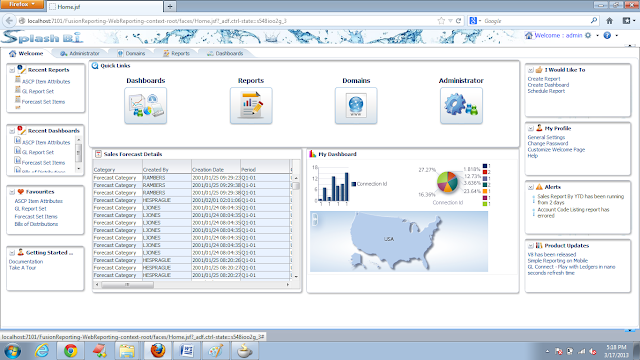
Take a look. Zoom in. Blow up the screen shot. Leave first impressions in the comments.
A few notes on the overall experience:
- ADF Essentials has not only performed better than advertised, it's changed our development team's thinking about how applications are developed.
- Thanks to ADF Essentials, we've built this product from scratch in under four months.
- The ADF Design Patterns, the ADF Rich Client User Interface Guidelines and the UX Direct tools were huge enablers in increasing productivity and cutting development cycle time.
Time for me to shut up now and let the product speak for itself. Here is a landing page screen shot from our latest iteration.

Take a look. Zoom in. Blow up the screen shot. Leave first impressions in the comments.
Thursday, December 06, 2012
ADF Essentials on Tomcat
I wrote the other day that I was doing some cool tech stuff, and I promised to update ya'all on my progress. Well, here we go.
As a non-techie functional type, I'm rather proud of myself from successful bringing up Oracle ADF Essentials on an Apache Tomcat web server and MySQL database. And I must give kudos here to Oracle Brazil's Raphael Rodrigues, who laid out a great set of instructions here.
I've tested this configuration out on various operating systems: Linux (Oracle, CentOS, Fedora, Ubuntu), Unix (OpenSolaris), Windows (XP, 7) and even...gulp...Apple's Mountain Lion (which is really Unix BeOS with some snazzy development thrown into the mix). All worked on my test beds.
Now, why would I go through all the trouble of doing this? Well, there are a few reasons:
1. As an E-Business User, I now have the opportunity to build ADF Rich Faces - based customizations in EBS 12.1.3 and externalize those customizations. In fact, I can even persistently externalize any data attribute customizations involved in those customizations in MySQL. And, if I'm really at the top of my game, I can use SOAP or REST integration to loosely-couple those integrations with EBS so the customizations survive any upgrades. Wow, maybe I can even get this to integrate with SaaS-based applications somewhere down the line?
2. Ditto for Fusion Applications.
3. Ditto for existing data warehouses.
4. Just as important as items 1-3 here...it was educational and fun!!!
More coming, as this is just the first increment in a much larger project. Questions? Thoughts? Jump on the comments.
As a non-techie functional type, I'm rather proud of myself from successful bringing up Oracle ADF Essentials on an Apache Tomcat web server and MySQL database. And I must give kudos here to Oracle Brazil's Raphael Rodrigues, who laid out a great set of instructions here.
I've tested this configuration out on various operating systems: Linux (Oracle, CentOS, Fedora, Ubuntu), Unix (OpenSolaris), Windows (XP, 7) and even...gulp...Apple's Mountain Lion (which is really Unix BeOS with some snazzy development thrown into the mix). All worked on my test beds.
Now, why would I go through all the trouble of doing this? Well, there are a few reasons:
1. As an E-Business User, I now have the opportunity to build ADF Rich Faces - based customizations in EBS 12.1.3 and externalize those customizations. In fact, I can even persistently externalize any data attribute customizations involved in those customizations in MySQL. And, if I'm really at the top of my game, I can use SOAP or REST integration to loosely-couple those integrations with EBS so the customizations survive any upgrades. Wow, maybe I can even get this to integrate with SaaS-based applications somewhere down the line?
2. Ditto for Fusion Applications.
3. Ditto for existing data warehouses.
4. Just as important as items 1-3 here...it was educational and fun!!!
More coming, as this is just the first increment in a much larger project. Questions? Thoughts? Jump on the comments.
Tuesday, August 28, 2012
OOW 2012 - Crystal Ball
I wonder what tomorrow has in mind for me
Or am I even in it's mind at all
Perhaps I'll get a chance to look ahead and see
Soon as I find myself a crystal ball
-- From Styx's Crystal Ball, Written by Tommy Shaw
Been asked a bunch lately about what new announcements & news I expect to hear from Oracle at Oracle OpenWorld next month. It's fun to prognosticate, even though I'm really, really bad at it. So, in the spirit of fun:
1. E-Business Suite: we'll see a pre-release demo and announcement. Emphasized points will be WebLogic and hot patching. My guess is we'll see GA in early 2013.
2. Fusion Applications: 3 announcements/demos:
4. Exasomethingorother: Do you really think we'll get through OOW without another hardware announcement of some sort?
5. Smurfvitdatasoc.com acquisition: At least one announcement of a company nobody has ever heard of who possesses technology that, when integrated into the Oracle product family, will forever change the way we do things.
So, now you have my predictions...including my humorous potshots on hardware and acquisitions. Keep in mind that my track record for predicting release dates is atrocious. So, anybody have any thoughts or anything to add? Hit the comments.
UPDATE (8/29/12): Silly me, I forgot to mention that we'll hear some cloud-related announcements other than SaaS for Fusion Apps [insert forehead slap here]. We'll hear tons about social and the cloud. In fact, I suspect OOW will be a real cloudapalooza.
Or am I even in it's mind at all
Perhaps I'll get a chance to look ahead and see
Soon as I find myself a crystal ball
-- From Styx's Crystal Ball, Written by Tommy Shaw
Been asked a bunch lately about what new announcements & news I expect to hear from Oracle at Oracle OpenWorld next month. It's fun to prognosticate, even though I'm really, really bad at it. So, in the spirit of fun:
1. E-Business Suite: we'll see a pre-release demo and announcement. Emphasized points will be WebLogic and hot patching. My guess is we'll see GA in early 2013.
2. Fusion Applications: 3 announcements/demos:
- We'll hear about a major release (likely won't call it 2.0, but that's essentially what it is) with a significant expansion in functionality. Project Portfolio Management functional reach will be greatly expanded. Again, a pre-announcement. GA? Around Dec. 2012.
- The entire Fusion Applications Suite on SaaS. The pricing scheme? Not likely. But at least GA for Fusion Apps on SaaS.
- An offering centered around important or core Fusion Applications business processes on SaaS. Probably rebranded, trimmed-down, and aimed at SME subscribers.
4. Exasomethingorother: Do you really think we'll get through OOW without another hardware announcement of some sort?
5. Smurfvitdatasoc.com acquisition: At least one announcement of a company nobody has ever heard of who possesses technology that, when integrated into the Oracle product family, will forever change the way we do things.
So, now you have my predictions...including my humorous potshots on hardware and acquisitions. Keep in mind that my track record for predicting release dates is atrocious. So, anybody have any thoughts or anything to add? Hit the comments.
UPDATE (8/29/12): Silly me, I forgot to mention that we'll hear some cloud-related announcements other than SaaS for Fusion Apps [insert forehead slap here]. We'll hear tons about social and the cloud. In fact, I suspect OOW will be a real cloudapalooza.
Subscribe to:
Posts (Atom)